
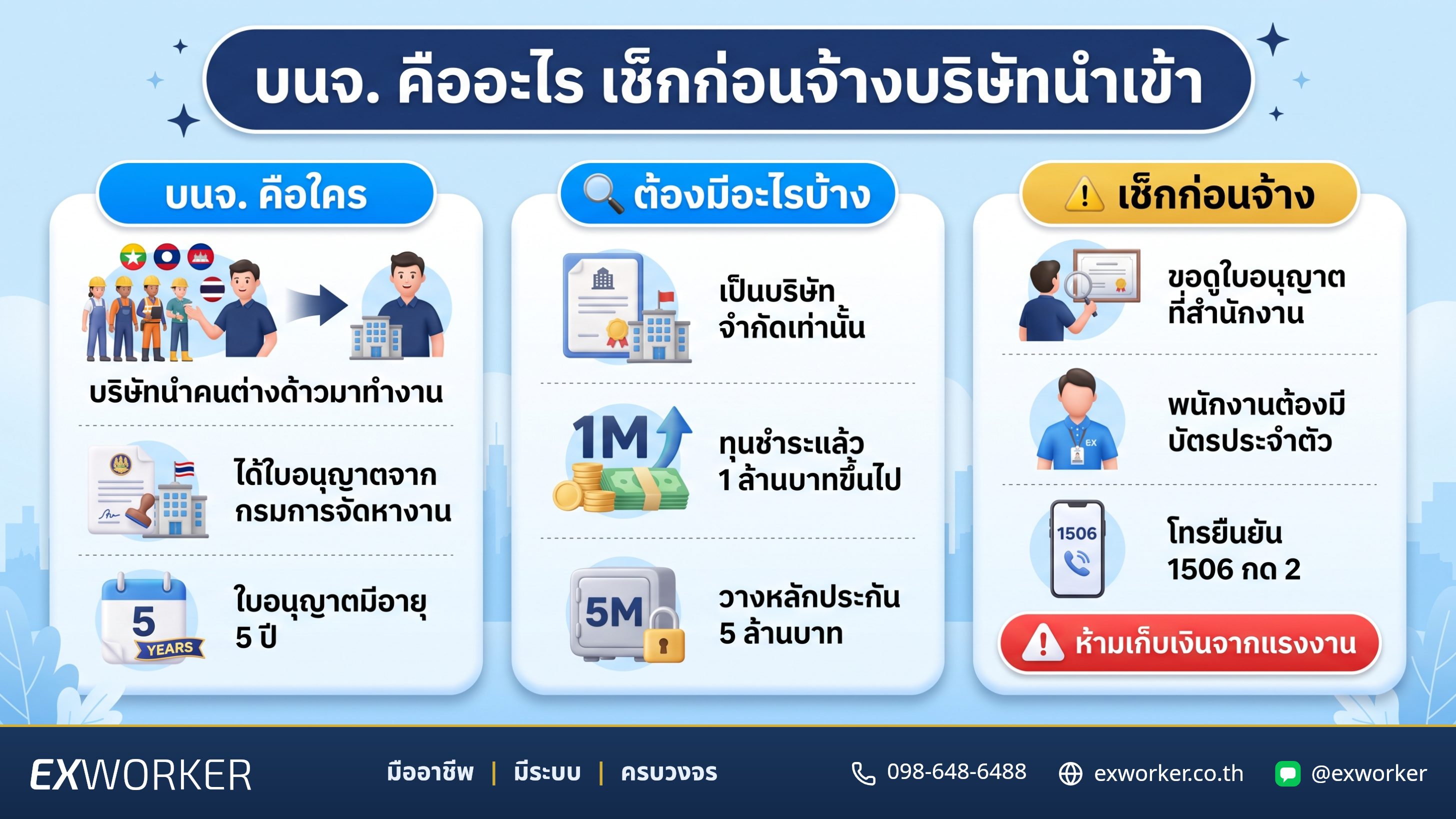
BNJ (บนจ.) is short for "บริษัทนำคนต่างด้าวมาทำงานในประเทศ", a company that brings foreigners to work in Thailand. The law calls it a licensee permitted to bring foreigners to work: a company licensed by the Director-General of the Department of Employment to bring foreign workers from abroad to work for employers in Thailand. Most of these are MOU workers from Cambodia, Laos, Myanmar and Vietnam.
The Exworker team summarised this article from the text of the Emergency Decree on the Management of Foreign Workers' Employment B.E. 2560 (2017) and its amendment B.E. 2561 (2018) as published by the Department of Employment, checked on 15 September 2026.
30-second summary
- A BNJ must be a limited company with paid-up capital of at least 1 million baht, and must place a guarantee of at least 5 million baht with the Department of Employment
- It may charge service fees only to the employer, no higher than the rates the Department announces. It must not collect money from the workers
- A company that brings in workers without a licence faces 1–3 years in prison or a fine of 200,000–600,000 baht
- Employers do not always have to hire a BNJ. They can do the MOU themselves
What does BNJ stand for?
BNJ = บริษัทนำคนต่างด้าวมาทำงานในประเทศ (a company bringing foreigners to work in the country). It is an abbreviation used in Ministry of Labour announcements and news, for example registration-round announcements stating that the people who may file on the worker's behalf are "the employer, or a company bringing foreigners to work (BNJ) that has been given power of attorney".
The law itself does not use the word BNJ. It uses "licensee permitted to bring foreigners to work", meaning a business operator that brings foreigners to work for employers in Thailand and already holds a licence (Section 5). If you see either term in a document, they mean the same thing.
How is a BNJ different from a recruitment agency or a broker?
| BNJ | General recruitment agency | Broker / unlicensed middleman | |
|---|---|---|---|
| Licence required | Licence to bring foreigners to work, under the 2017 Emergency Decree | Recruitment licence under the recruitment law (a different licence) | None |
| Can it bring foreign workers in from abroad? | Yes, under its contract with the employer and the name list notified to the registrar | No, not without a licence to bring foreigners to work | No, it is a criminal offence |
| Can it collect money from workers? | No | — | Illegal |
The common mistake is this: a recruitment licence does not mean a company can import foreign workers. Before hiring, ask clearly which type of licence the company holds.
What does a company need to become a BNJ?
Under Sections 27 and 28, an applicant must meet these main requirements:
- It must be a limited company or public limited company only. Individuals and partnerships cannot apply
- Registered and paid-up capital of at least 1 million baht
- Thai shareholders must hold at least 3/4 of the capital, and at least 3/4 of the shareholders must be Thai
- A dedicated, publicly visible office at a fixed location
- The manager who is an authorised director must be Thai, at least 20 years old, and free of any disqualification under the law
- It must place a guarantee of at least 5 million baht with the Director-General before receiving the licence. If any of it is deducted to pay for damage, the company must top it up in full within 30 days
The licence is valid for 5 years and the company must pay an annual fee. If it does not pay on time, the Director-General may suspend the licence (Section 30).
Who does the 5 million baht guarantee protect?
The guarantee is money the state holds in case the company causes damage. For example, if a court orders the company to refund overcharged money and it does not refund it within 30 days, the Director-General can deduct the amount from the guarantee and return it to the employer or the worker (Section 111). It also covers cases where workers must be sent back to their home country but the company fails to do so.
If the company closes down, it gets the guarantee back only if it can prove it has sent the workers home, within no more than 2 years from closing. After that deadline the money goes to the fund. This is why using a genuinely licensed BNJ is safer than a middleman with nothing backing them at all.
What can a BNJ do on the employer's behalf?
- Sign a contract with the employer to bring foreigners to work — listing each worker's name, nationality and passport number. It may bring in workers only up to the number and names in the contract (Section 41)
- Send a copy of the contract and notify the name list to the registrar — once the names and passport numbers are available, the registrar notifies the Immigration Bureau or other relevant agencies (Section 41, paragraph 3)
- Apply for work permits on the workers' behalf — this can be done after the information has been notified to the registrar
- Hand the workers over to the employer, then notify the registrar within 15 days — failing to notify carries a fine of up to 20,000 baht for the company (Sections 43, 107)
Besides importing workers, in registration or renewal rounds under cabinet resolutions, some announcements also allow a BNJ holding a power of attorney to file applications on the worker's behalf. For the full import process, see importing Lao and Myanmar MOU foreign workers legally.
How much can a BNJ charge?
A BNJ may charge service fees only to the employer, and only for the items and at the rates announced by the Director-General of the Department of Employment (Section 42). It must not demand or accept any money or property from the workers at all.
The service fee a company bringing foreigners to work may charge an employer is no more than 25% of the first month's wage of each worker, and the cap falls to 20%, 15% and 10% as the number of workers increases.
Department of Employment announcement of 30 June 2021 · Royal Gazette Vol. 138, Special Part 223 Ngor (17 September 2021)Violations carry imprisonment of up to 1 year and a fine of twice the money demanded or received, and the court may order a refund (Section 111). Government fees, health check fees and home-country document fees are separate from the service fee, so ask the company to itemise them every time. For the overall cost, see the annual cost of hiring one migrant worker.
How do you check that a company is a real BNJ?
- Look for the company name in the Department of Employment's list — the Foreign Workers Administration Office publishes the file list of companies in Thailand licensed to bring foreigners to work for employers in the country. The 11 June 2026 edition lists 346 companies, each with its name, licensee, address and licence number (นจ.). Compare it with the licence the company shows you
- Ask to see the licence to bring foreigners to work — the law requires it to be displayed openly, where it can easily be seen, at the office stated on the licence (Section 32). Check that the company name, address and expiry date match
- Ask to see the ID card of the person talking to you — managers and staff doing import work must carry an ID card with a copy of the licence (Section 35). Be careful if they are just "someone the company knows" with no card
- Check the company with the Department of Business Development — it must be a limited or public limited company with paid-up capital of at least 1 million baht
- Confirm directly with the authorities — if you cannot find the name, or the company was licensed after the date of the file, call the Department of Employment hotline 1506, press 2, with the company name and licence number
Exworker is on this list too, at number 101, under the name "บริษัทนำคนต่างด้าวมาทำงานในประเทศ เอ็กซ์เวิร์คเกอร์ จำกัด", licence number นจ.0122/2561. You can check us the same way.
For a checklist that also covers general document agencies, read choosing a migrant worker document agency: what to check.
Got a quotation from an import company and not sure whether it exceeds the cap? Send the items to Nong X to help break them down. Free answers, no registration needed.
Which employers cannot use a BNJ?
Labour subcontractors or labour-only contractors (Section 41). A BNJ cannot supply workers to this group of employers, and it cannot act as a labour subcontractor itself. Violations carry imprisonment of up to 1 year or a fine of up to 200,000 baht (Section 110/1). If a company offers to "send people straight to work at our client's site", treat it as a danger sign.
Do you have to hire a BNJ, or can you do the MOU yourself?
You do not have to hire one. An employer who is not a labour subcontractor can file the hiring request and import MOU workers on its own under Section 46, by placing a guarantee of 1,000 baht per worker, up to a total of 100,000 baht.
- Do it yourself — no service fee, but you need someone to coordinate with the home country, take documents through several agencies, and take responsibility yourself at every step
- Through a BNJ — you pay a service fee within the cap, and the company takes on notifying the registrar and filing documents for you, backed by its 5 million baht guarantee
If your business already has a full-time person handling documents, doing it yourself is usually better value. Read the full steps in employers doing the MOU themselves 2026, and compare the two routes in detail in importing MOU workers from 4 nationalities: do it yourself or hire a company. If you want a team to handle the import for you, see MOU foreign worker import service.
What you must never do
Never let a company or broker collect money from the workers, whether it is called a head fee, a queue booking fee or a wage deduction. If a company suggests this so the employer pays less, drop it immediately, however cheap it is.
- Do not pay anyone who is not a BNJ staff member with a card. A person who carries out imports without being an employee the company has notified faces imprisonment of up to 3 years or a fine of up to 600,000 baht (Section 110)
- Do not sign a contract that does not list the workers' names and passport numbers. The law allows imports only according to the names in the contract
- Do not pay a service fee without an itemised receipt, because you cannot prove whether it exceeds the cap
Common misunderstandings
- Many people think any company with a recruitment licence can import foreign workers. In fact it needs a separate licence to bring foreigners to work
- Many people think that once they hire a BNJ, the employer has no duties. In fact the employer must still make a written employment contract, notify the worker's start and end of employment, and look after the work permits itself. See notifying migrant workers' start and end of employment
- Many people think it is normal for workers to pay the import costs themselves. For a BNJ, collecting money from workers is plainly illegal
- Many people think you must hire a BNJ to import workers. Employers can do the MOU themselves, except labour subcontractors
What to do if you have already hired an unlicensed company
- Keep all the evidence: contracts, receipts, chats and the names of the people you dealt with
- Check each worker's status: whether they hold a valid work permit that names you as the employer. If there is a problem in the system, see data not found in the e-Work Permit system: how to fix it
- If a worker does not yet have valid documents, do not let them keep working until it has been put right, because an employer who takes on a foreigner without the right to work faces penalties of its own. See fines for hiring foreigners illegally
- Contact your provincial employment office or call 1506, press 2, for advice before deciding the next step
Frequently asked questions
Is a BNJ the same as an MOU company?
In practice, a legal "MOU import company" is a BNJ, because bringing in workers on an employer's behalf requires a licence to bring foreigners to work. But not every company that calls itself an "MOU company" holds a licence, so ask to see the licence first.
How long is a BNJ licence valid?
5 years from the date the licence is issued, and an annual fee must be paid. To renew, apply at least 30 days before it expires.
Can a BNJ deduct import fees from a worker's wages?
No. Section 42 prohibits demanding or accepting money or property from foreigners. Service fees can be charged only to the employer, at the announced rates.
Can an individual be a BNJ?
No. It must be a limited company or public limited company with paid-up capital of at least 1 million baht.
Is there a list of BNJs to check online?
Yes. The Department of Employment publishes the list of companies licensed to bring foreigners to work for employers in the country as a PDF file. The latest edition our team checked is dated 11 June 2026, with 346 companies. The same page also lists the companies in Myanmar, Cambodia, Laos and Vietnam licensed to send workers to Thailand. If you cannot find the company you are talking to, confirm with the 1506 hotline, press 2, before paying anything.
References
- Foreign Workers Administration Office, Department of Employment — list of companies licensed to bring foreigners to work for employers in the country, as of 11 June 2026
- Emergency Decree on the Management of Foreign Workers' Employment B.E. 2560 (2017) · Royal Gazette Vol. 134, Part 65 Kor (22 June 2017) — Sections 26, 27, 28, 32, 105
- Emergency Decree on the Management of Foreign Workers' Employment (No. 2) B.E. 2561 (2018) · Royal Gazette Vol. 135, Part 19 Kor (27 March 2018) — Sections 5, 30, 35, 41, 42, 43, 107, 110, 110/1, 111
- Department of Employment announcement dated 30 June 2021 on the items and rates of service fees and expenses · Royal Gazette Vol. 138, Special Part 223 Ngor (17 September 2021)
Information as of the check date, 15 September 2026




Comments
0 commentsNo comments yet
Leave a comment
Every comment is reviewed before it appears.