
Employer DIY MOU Worker Import: Steps, Fees, Pitfalls
Employers can file MOU worker imports themselves, but it means two official manuals in sequence. Thai-side steps, fixed fees and where employers get hurt.
Yes. Thai law allows an employer to file for MOU migrant worker import directly, without going through a licensed recruitment company. What most employers do not realise is that this is not one set of forms but two official procedure manuals that must be completed in sequence, and the stage that actually takes the longest — coordination with the country of origin — has no timeframe fixed by any Thai regulation.
This article covers what the do-it-yourself route involves, which fees have a fixed official rate, which costs nobody has set a figure for, and where employers get hurt. The ExWorker team compiled this from the Department of Employment's public procedure manuals and from the Emergency Decree on Managing the Work of Aliens B.E. 2560 (2017) as amended by the second edition B.E. 2561 (2018), last verified on 25 August 2026.
Information verified as of 27 August 2026
Can an employer import MOU workers themselves? What the law says
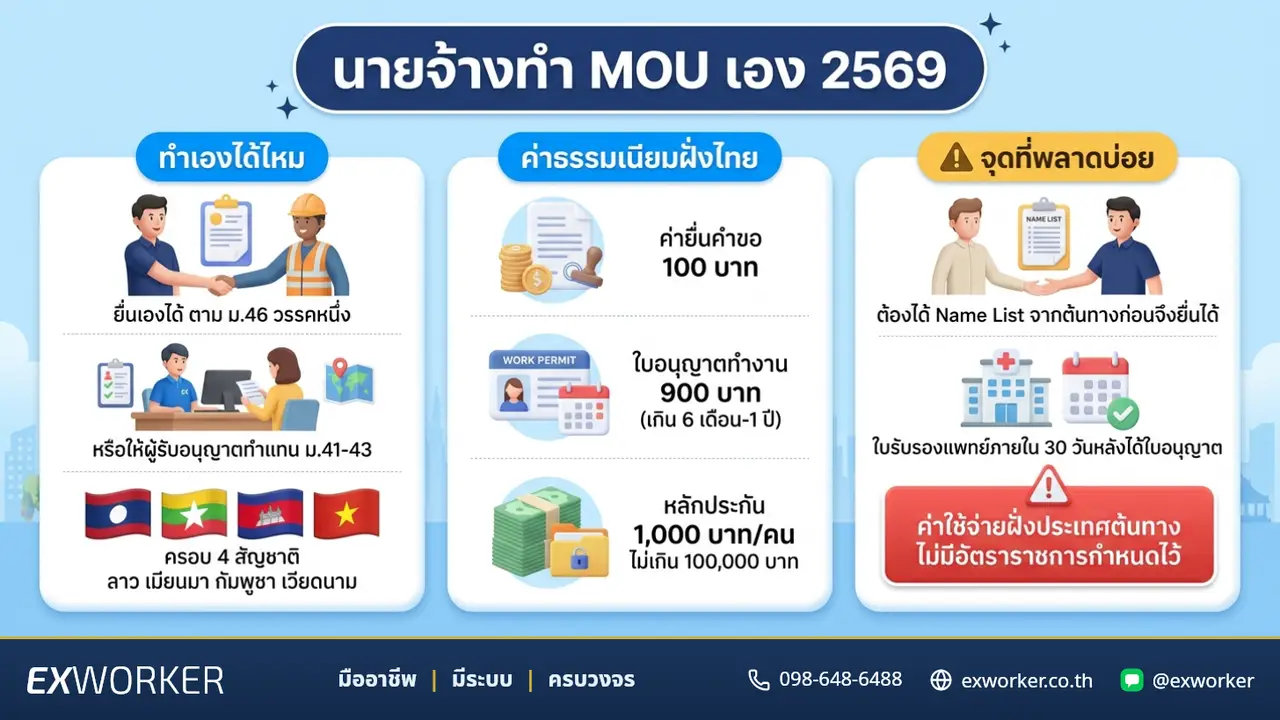
The MOU system covers four nationalities: Cambodia, Laos, Myanmar and Vietnam. The law provides two routes.
- The employer handles it directly — the employer notifies the registrar of its demand for alien workers under Section 46, paragraph one
- A licensed importer handles it on the employer's behalf — under Sections 41 to 43, and once the licensee delivers the alien workers to the employer it must notify the registrar within 15 days, under Section 43
Security deposits are widely misunderstood. Section 46, paragraph two says the Director-General may require employers importing alien workers in prescribed categories of work to place a security deposit. That is a discretionary power tied to specific work categories, not a blanket obligation on every employer. The rate stated in the Department of Employment's public manual for the employer-handled route is 1,000 baht per worker, capped at 100,000 baht. Before filing, ask your provincial employment office whether your category of work falls within the requirement.
Doing it yourself versus hiring a licensed importer
The real difference is not "cheaper" or "more expensive" but who carries the coordination work in the country of origin. The Thai-side procedure is identical either way: same manual, same government fees. What differs is the origin-country stage, for which no Thai regulation fixes either a timeframe or a cost.
If you have not decided which route to take, see the detailed comparison in Importing MOU migrant workers of 4 nationalities: do it yourself or hire a company. And if you are not yet sure whether the MOU system or a cabinet-resolution round is right for you, read MOU workers versus cabinet-resolution workers first — picking the wrong legal basis at the start is always more expensive to fix later.
The MOU process is two manuals, not one
The Department of Employment's public procedure manuals split this into two books that must be done in order. The first must be finished before the second can be filed at all.
| Manual | What it does | Required output |
|---|---|---|
| Book 1 | File the demand for workers, then coordinate with the country of origin | An original Name List certified by the country of origin |
| Book 2 | Use the Name List to apply for work permits on the workers' behalf | Non-Immigrant L-A visa · training at the reception centre · work permit issued |
This is where do-it-yourself employers most often come unstuck: they prepare the full Book 2 document set but still have no country-certified Name List, so nothing can be filed and the whole cycle is lost. For the full picture of the process, read 6 steps for importing MOU migrant workers alongside this article.
The Thai-side sequence, step by step
- File the application with supporting documents — at the provincial employment office, or Bangkok employment office areas 1 to 10, in the district where the workplace is located. Pay the application fee and the work permit fee. If you are handling the import yourself and your category of work falls within the requirement, the security deposit is placed at this stage.
- Officials record the data and certify the Name List — and issue the letter regarding the Non-Immigrant L-A visa together with the letter to the Immigration Bureau.
- Workers travel in and attend the training — at the Centre for Reception of Workers and Termination of Employment, after which the registrar signs and each worker collects their work permit in person.
Do not trust anyone who promises a number of days The sequence above covers the Thai side only, and only once documents are complete. The stage of coordinating with the country of origin until a certified Name List is issued has no timeframe fixed by any Thai regulation. If someone commits to a fixed completion date, ask to see the source before you decide.
Documents and forms you will need
- The Name List certified by the country of origin — original
- Form BT.46 employment certification letter
- Form BT.31 application to work on behalf of alien workers under Section 41, paragraph four — used where a licensee handles the process
- Form NJ.4 licence to bring alien workers into the country
- Form NJ.2 petition to bring alien workers to work — filed in advance when bringing back workers who have completed their term
- Form BT.42 electronic work permit, valid 2 years — the manual states that Vietnamese nationals use the paper form BT.39
One task after the work permit is issued gets forgotten often: the worker must submit a medical certificate together with a copy of the immigration record within 30 days of receiving the work permit. Miss that deadline and the registrar may revoke the permit.
Thai-side costs with a fixed official rate
Application fee 100 baht per copy · work permit fee for over 6 months up to 1 year 900 baht, with a pro-rata addition beyond one year · security deposit for the employer-handled route 1,000 baht per worker, capped at 100,000 baht
Department of Employment public manual (citing the Ministerial Regulation on Fees B.E. 2563) · verified 25 August 2026Two figures we deliberately will not give you, because no primary source confirms them: a single combined work permit fee figure for the full two years, and costs incurred in the country of origin. On the latter, Thai law states only that these are the alien worker's own personal expenses, under the Department of Employment notification dated 30 June 2021, clause 5(2). If anyone advertises origin-country costs as a fixed price, ask for the source. For the whole-year cost picture of employing one worker, see the annual cost of hiring one migrant worker.
If you hire a licensed importer, what is the service fee cap?
The Department of Employment notification dated 30 June 2021 caps the service fee a licensee may charge an employer at no more than 25% of the first month's wages, stepping down to 20%, 15% and 10% as worker numbers rise. More important still, the same notification prohibits charging any money to the workers themselves. If a pricing structure ends up deducting from employees' pay, that is a signal to walk away, not something to negotiate.
Not sure whether your category of work requires a security deposit? Ask Nong X — free, no sign-up needed.
Where are the reception centres, and how do Laos and Myanmar differ?
| Nationality | Centre for Reception of Workers and Termination of Employment | Non-Immigrant L-A visa channel |
|---|---|---|
| Laos | Mukdahan · Nong Khai | The Department of Employment writes to the Royal Thai Embassy in the country of origin |
| Myanmar | Tak · Ranong | The Department of Employment writes to the Embassy of Myanmar in Thailand, and the workers obtain the visa at the immigration checkpoint before entering Thailand |
| Cambodia | Sa Kaeo | As designated by the Department of Employment case by case |
| Vietnam | No reception centre — training and permit collection at the local employment office | As designated by the Department of Employment case by case |
Centre locations are current as of August 2026 and can change, so confirm with your provincial employment office before planning arrival dates. The difference in visa channel between Laos and Myanmar is the single point employers most often get wrong, because they plan the arrival date using the process that applies to the other nationality.
What you must never do
- Never let a worker start before the work permit is issued — taking on alien workers in breach of Section 9 carries a fine of 10,000 to 100,000 baht per alien worker under Section 102. The full penalty list is in illegally employing migrant workers: what penalties do employers face
- Never hold a worker's passport or work permit, no matter how much you paid on their behalf — it is a risk to you both legally and in the eyes of inspectors
- Never push import costs onto the workers — the Department of Employment notification of 30 June 2021 prohibits it outright
- Never rely on expired measures, such as the arrangement allowing workers to exit at the border and re-enter immediately, which ended on 31 December 2024
Common misunderstandings
Many people believe there is a 2026 cabinet resolution that changed the MOU conditions. In fact the ExWorker team reviewed the 2026 cabinet resolutions on 25 August 2026 and found no 2026 resolution relating to the MOU system. The resolutions issued this year concern the relaxation groups and work permit renewals, which rest on a different legal basis. That is the result of our search, not a confirmation that none exists — if a more recent official announcement appears, follow the latest official version.
The other misunderstanding is that finishing the MOU means you are set for years. In reality an MOU work permit is valid for 2 years and there is a contract renewal cycle to prepare for in advance — see MOU migrant workers completing 2 years. And if a worker asks to change employer mid-term, the conditions for the MOU group are not the same as for the cabinet-resolution group — see changing employer for migrant workers.
Checklist before you decide to do it yourself
- Do you actually have someone who can coordinate with the country of origin? That is the stage no Thai manual governs
- Have you asked your provincial employment office whether your category of work requires a security deposit?
- Have you budgeted the government fees per worker, kept separate from origin-country costs that have no fixed rate?
- Have you planned the arrival date around the reception centre and visa channel for that specific nationality?
- Do you have a reminder in place for the medical certificate due within 30 days of the work permit being issued?
- If most answers are "not yet", using a licensed importer may cost less in time lost. See the scope of what we handle at MOU migrant worker import from Laos and Myanmar
Frequently asked questions
Does every employer doing MOU themselves have to place a security deposit?
No. Section 46, paragraph two empowers the Director-General to require a deposit only for prescribed categories of work. It is discretionary, not a blanket rule. The rate stated in the manual for the employer-handled route is 1,000 baht per worker, capped at 100,000 baht. Confirm with your provincial employment office whether your category falls within it before filing.
How long does doing MOU yourself take?
There is no official figure for the whole process. The Thai side follows the sequence set out in the manual once documents are complete. The stage of coordinating with the country of origin until a certified Name List is issued has no timeframe fixed by Thai regulation, so it cannot be reduced to a firm number. Plan your workforce with a time buffer rather than around a date someone promised.
How much does the Laos or Myanmar side cost?
No Thai regulation sets a rate. Thai law states only that costs arising in the country of origin are the alien worker's own personal expenses, under the Department of Employment notification dated 30 June 2021, clause 5(2). Figures quoted in the media are individual estimates, not official rates.
Did a 2026 cabinet resolution change the MOU conditions?
From the ExWorker team's review on 25 August 2026, no 2026 cabinet resolution relating to the MOU system was found. The resolutions issued this year concern the relaxation groups and work permit renewals, which rest on a different legal basis. Always confirm with your provincial employment office, or the hotline 1506 press 2, before proceeding.
Can imported workers change employer?
Only under the conditions applying to the MOU group, which are stricter than for the cabinet-resolution group, and within a set period for starting work with the new employer. The full conditions are in our article on changing employer. If you are taking on workers for the first time, read hiring new migrant workers: what must the employer do as well.
Sources and verification date
- Emergency Decree on Managing the Work of Aliens B.E. 2560 (2017), as amended by the second edition B.E. 2561 (2018) — Sections 41 to 43, Section 46, Section 102
- Department of Employment public procedure manuals — bringing Cambodian, Lao, Myanmar and Vietnamese nationals to work in Thailand, and applying for work permits on behalf of alien workers
- Department of Employment notification dated 30 June 2021 (Government Gazette, Volume 138, Special Part 223 Ngor, 17 September 2021) — service fee caps and the prohibition on charging alien workers
- Ministerial Regulation on Fees B.E. 2563 (cited via the public manual)
Information last verified on 27 August 2026. Laws and local practice can change; before proceeding, confirm with your provincial employment office or the Department of Employment hotline 1506 press 2.
Comments
0 commentsNo comments yet
Leave a comment
Signed-in comments appear immediately — no review wait.
Every comment is reviewed before it appears.