
Thailand's 2026 Deportation Regulation: Employer Guide
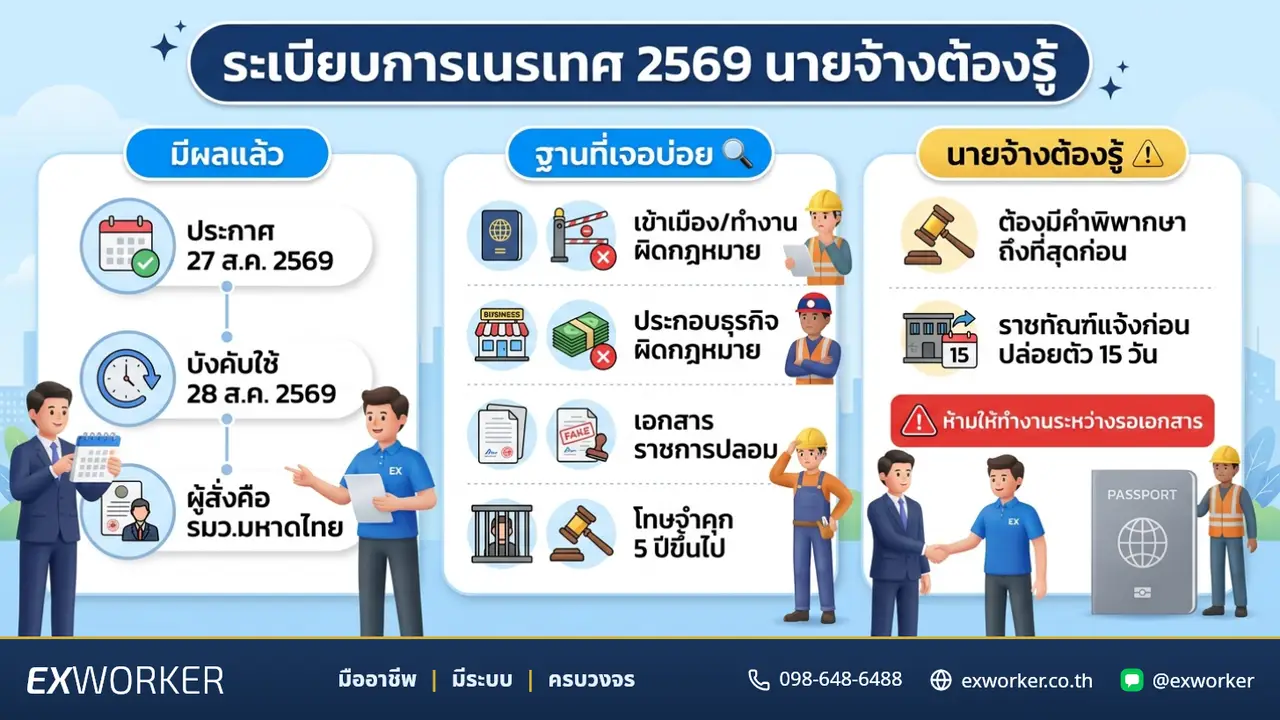
Thailand's Deportation Regulation B.E. 2569 took effect 28 Aug 2026. The six grounds, the procedure and deadlines, and what employers must know.
Thailand's 2026 Deportation Regulation: What Employers of Migrant Workers Need to Know
The Prime Minister's Office Regulation on Deportation B.E. 2569 (2026) has been in force since 28 August 2026. What it does is set out the procedure for the state to order the deportation of foreign nationals more quickly — it does not create new offences. One of the six grounds for deportation is working in the Kingdom unlawfully, which concerns employers directly.
The most common misunderstanding is that arrest leads straight to deportation. In fact, under Clause 5 the person must have a final court judgment, serve the sentence in full and be released from prison first before the Minister of Interior has the power to order deportation.
The Exworker team prepared this article from the full text published in the Government Gazette, Volume 143, Special Part 205 Ngor, pages 1–3, dated 27 August 2026 — not from news summaries, because several outlets reported the time limits incorrectly.
Information verified as of 28 August 2026
What the 2026 Deportation Regulation is — and is not
It is an administrative regulation issued by the Prime Minister with the approval of the Cabinet, under section 11 (8) of the Administration of State Affairs Act B.E. 2534 (1991). Its job is to tell state agencies who forwards a case to whom, within how many days, and through which route the person is sent out.
What this regulation does not do is create new offences or increase penalties. The power to order deportation belongs to the existing law on deportation. This regulation only makes the process faster and consistent across every province.
| Item | Detail |
|---|---|
| Full name | Prime Minister's Office Regulation on Deportation B.E. 2569 |
| Signed | 26 August 2026 by Mr. Anutin Charnvirakul, Prime Minister |
| Published in the Government Gazette | 27 August 2026 (Vol. 143, Special Part 205 Ngor) |
| In force | 28 August 2026 (the day after publication) |
| Authority to order deportation | Minister of Interior |
Who can be deported: the six grounds under Clause 5
Clause 5 lists six offences. Once the foreign national has served the sentence under a final judgment in full and been released from prison, the Minister may order deportation from the Kingdom.
- Entering or staying in the Kingdom unlawfully under the immigration law
- Working in the Kingdom unlawfully under the law on the management of foreign workers' employment
- Operating a business unlawfully under the law on foreign business operation
- Forging official documents or using forged official documents
- Committing an offence carrying a prison term of five years or more
- Acting as a principal, instigator or supporter of any act under items 1–5
Ground 2 is the one employers must read closely: it covers both working without a work permit and working outside the conditions permitted. Ground 4 is the reason we wrote about screening for forged documents before hiring in the first place.
Deportation for conduct — no court judgment required
Besides Clause 5, which requires a court process, Clause 4 opens a second route: a foreign national whose behaviour or conduct is contrary to public order, good morals or the well-being of the public may be reported by the Permanent Secretary of the Ministry of Interior (or their delegate) to the Minister for a deportation order directly.
The second paragraph of Clause 4 extends this to foreign nationals who are instigators or supporters of such conduct. The regulation does not define what conduct qualifies, so this is entirely at administrative discretion.
The procedure and its deadlines: who does what, and when
- At least 15 days before release — the Director-General of the Department of Corrections notifies the Permanent Secretary of the Ministry of Interior of the person's name, nationality, case file or relevant documents
- Without delay — the Permanent Secretary reports to the Minister for consideration of a deportation order
- The order is issued — the deportation order may also specify a period during which the person is barred from re-entering the Kingdom
- Removal — an officer designated by the Minister returns the person to the country of their nationality, through the checkpoint and route prescribed by the Permanent Secretary of the Ministry of Interior
The regulation is equally clear on another case: where a final judgment imposes imprisonment but the sentence is suspended, or a fine is imposed instead, the Office of the Judiciary must notify the Permanent Secretary of the Ministry of Interior urgently. In other words, this route applies even without actual time served.
Where is someone sent if their nationality is uncertain?
Clause 7 answers this directly: the person is returned to the country they declare they last resided in before entering the Kingdom. All removals must go through the checkpoints, routes and methods prescribed by the Permanent Secretary of the Ministry of Interior — an announcement that had not yet been issued as of our verification date.
Can a third country ask to receive the person?
Yes, but the conditions are tight. Under Clause 8, another country where the person does not hold nationality, or an international organisation, must submit a written request through diplomatic channels within seven days of the deportation order, citing the need to protect the person from torture, cruel, inhuman or degrading treatment, or enforced disappearance.
Two further conditions must be met: the requesting country must bear all costs of both custody before removal and the removal itself, and the person must consent in writing.
Once those conditions are met, the transfer must be completed within 30 days of Thailand receiving the request, extendable twice, by no more than 30 days each time. If the deadline passes and the transfer still cannot be made for any reason, Clause 7 applies again: the person is returned promptly to the country of their nationality.
15 days, 7 days, 30 days — do not mix them up
| Number | Which step it belongs to |
|---|---|
| 15 days | The Department of Corrections notifies the Ministry of Interior before releasing the person from prison |
| 7 days | A third country or international organisation submits a request through diplomatic channels, counted from the date of the deportation order |
| 30 days (extendable twice) | Completing that requested transfer |
Several news outlets described the 15-day figure as "advance notice to the person being deported", which does not match the text — the 15 days is the deadline for the Department of Corrections to send information to the Ministry of Interior, an internal state step. The Exworker team checked this against page 2 of the regulation on 28 August 2026.
Can a Thai employer be deported too?
No. This regulation applies only to "foreign nationals"; Thai employers fall outside its scope. But there are two things to know.
First, Clause 5 (6) covers foreign nationals who are principals, instigators or supporters of the offences in grounds 1–5. If your business has a foreign partner or manager, those people are within the scope of the regulation.
Second, penalties for Thai employers who hire workers unlawfully come from a different law — the Emergency Decree on the Management of Foreign Workers' Employment. We set out the figures that are still in force in Hiring migrant workers illegally: what are the fines?. A worker being deported does not erase the employer's liability, and an employer being fined does not spare the worker from deportation.
Not sure whether your workers are doing exactly the work they were permitted to do? Ask Nong X — tell us the job type and the resolution group they hold. Free, no sign-up needed.
The real cost to employers: losing a worker permanently, not temporarily
The damage employers tend to underestimate is this: a worker pushed back through the ordinary immigration mechanism can still return through the proper system. A deportation order, however, may specify a period barring re-entry to the Kingdom. That means the document fees, health check costs and time invested in that worker are gone for good.
One clarification: the regulation does not state how many years the ban lasts. It says only that a period may be specified. Anyone telling you "deportation means a five-year or ten-year ban from Thailand" is going beyond the text. The comparison between deportation and push-back above is the Exworker team's explanation, not wording from the regulation.
What you must never do
- Never let a worker start work while documents are pending — unlawful work is a direct ground for deportation under Clause 5 (2)
- Never accept documents that "someone arranged" without seeing where they came from — forged official documents are a ground for deportation under Clause 5 (4), and using them is an offence in itself
- Never hold a worker's passport or permit to stop them leaving — it is unlawful and it helps you not at all once a deportation order exists
A checklist for employers and HR
- Every worker holds a valid work permit and is doing the job type they were permitted to do
- Verify the documents a worker presents on day one, not when an inspection happens
- File entry and exit notifications on time — see Hiring new migrant workers: what employers must do
- File the residence notification under immigration law — see TM.30 residence notification
- Workers complete their 90-day reporting on schedule — see 90-day reporting
- If you plan to change the job type, file before the new work begins — see Job type change service
If a worker is already facing charges, what can the employer do?
Once a case reaches the courts, deportation is the Minister of Interior's power; an employer has no standing to stop it. Two things remain within your control.
First, settle outstanding wages and file the exit notification correctly — your notification duties do not disappear because the worker is facing charges. Second, review whether everyone else in the business holds correct status. Ground 5 (6) on principals, instigators and supporters means one person's case can reach others.
On replacing the worker, we cover that separately in When a worker resigns after the employer paid for the documents, including how to think about the money already spent.
Common misunderstandings
| Many people think | The reality |
|---|---|
| It is a new law aimed at cracking down on migrant workers | It is an administrative regulation that speeds up an existing procedure; it adds no offence and no penalty |
| Arrest means immediate deportation | The grounds under Clause 5 require a final judgment and release from prison first |
| Deportation and push-back are the same thing | They are different mechanisms; this regulation says nothing about immigration push-back |
| Deportation means a five-year ban from Thailand | The regulation says only that a period "may be specified" — no number of years appears in the text |
| This regulation applies to employers as well | It applies to foreign nationals only; employer penalties sit in a different law |
Frequently asked questions
When did the 2026 Deportation Regulation take effect?
It has been in force since the day after publication in the Government Gazette — 28 August 2026.
Who issues a deportation order?
The Minister of Interior, on a report submitted by the Permanent Secretary of the Ministry of Interior.
Will a worker without a work permit be deported immediately?
No. Clause 5 requires the person to have served the sentence under a final judgment in full and been released from prison before the Minister may order deportation.
Can someone return to Thailand after being deported?
The regulation says the order may also specify a period barring re-entry, but gives no number of years. For an individual case, confirm with the Ministry of Interior or the Damrongtham Center hotline 1567.
Who pays the cost of deportation?
Clause 9 leaves this to a regulation issued by the Ministry of Interior with the approval of the Ministry of Finance, which had not been issued as of our verification date. Where a third country requests the person under Clause 8, the requesting country bears all costs.
Can an employer object to a worker's deportation order?
The regulation gives employers no such right. Under Clause 7, the power to revoke an order rests with the Prime Minister. This point can be read in more than one way — consult a legal adviser before taking any step.
Sources
- Prime Minister's Office Regulation on Deportation B.E. 2569 — Government Gazette, Vol. 143, Special Part 205 Ngor, pages 1–3 (27 August 2026)
- Administration of State Affairs Act B.E. 2534, section 11 (8)
- Public Relations Department — announcement of the Prime Minister's Office Regulation on Deportation B.E. 2569
Comments
0 commentsNo comments yet
Leave a comment
Signed-in comments appear immediately — no review wait.
Every comment is reviewed before it appears.