
Migrant Worker Quit After You Paid for Documents? Do This
A worker resigned or disappeared after you paid for documents? Legal duties within 15 days, what is strictly prohibited, and how to limit future losses.
It's a common scenario: paying for work permit renewal, health checks, and document processing, only for the employee to resign or disappear after a few months. The question is: What are the employer's legal obligations now, and what actions are prohibited?
Summary in 30 Seconds
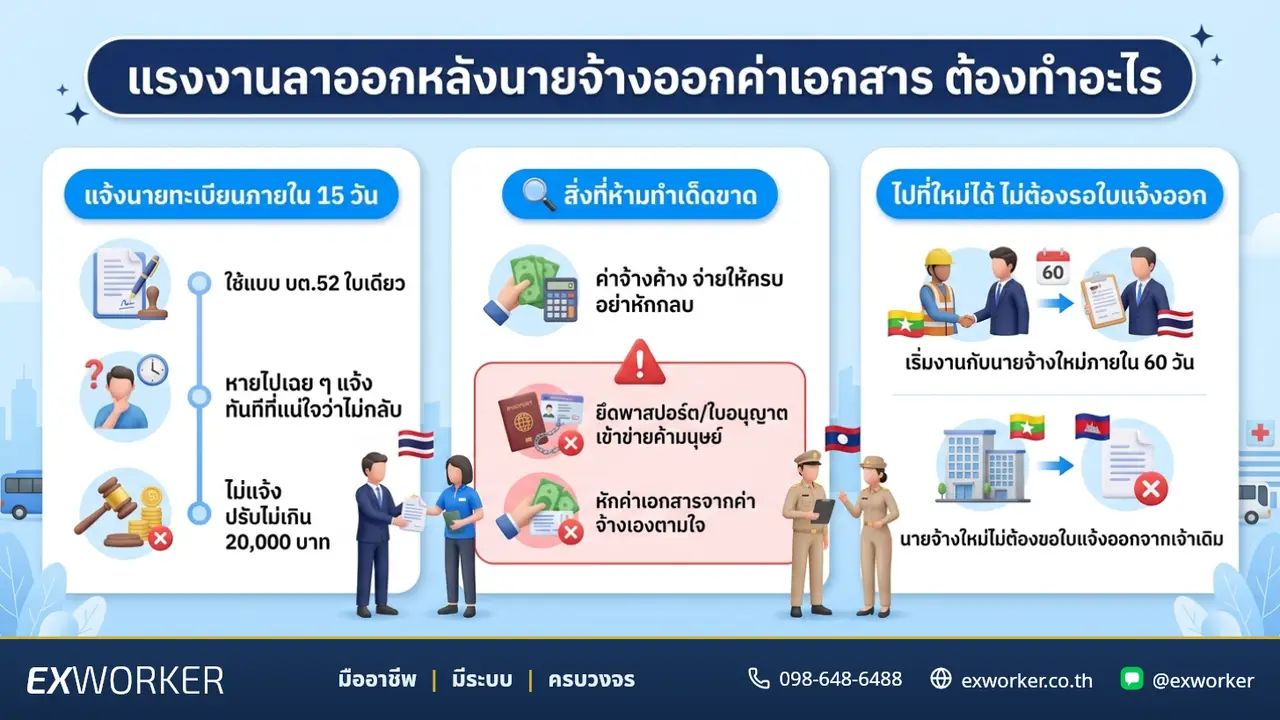
- Notify the registrar within 15 days using form บต.53 (BT.53) — Failure to notify incurs a fine not exceeding 20,000 Baht.
- Do not confiscate passports or deduct document fees from wages, regardless of the amount spent.
- You do not need to wait for a "notification of resignation" from anyone, and the new employer does not need to request it from you.
First Step: Notify the Registrar within 15 Days
When a migrant worker leaves employment, the employer is obligated to notify the registrar within 15 days in accordance with Section 13 of the Royal Ordinance on the Management of Migrant Worker Employment B.E. 2560 (2017) (as amended by the second edition B.E. 2561 (2018)) — Failure to notify incurs a fine not exceeding 20,000 Baht under Section 103.
This is where employers most frequently incur unnecessary duplicate expenses, as they lose an employee and then have to pay a fine, even though the notification only requires form บต.53 (BT.53), the form used to report a worker leaving employment.
If the employee disappears without notice, notify immediately once you are certain they will not return. Do not wait for 15 days to pass before starting to count, as the start date for counting in such cases can be interpreted in various ways. Early notification incurs no penalty; late notification incurs a penalty.
Strictly Prohibited Actions
- Do not confiscate the employee's passport, work permit, or identification card, whether to prevent them from fleeing or to guarantee the return of document fees — Besides being a legal risk, this behavior is viewed by inspectors as potentially constituting human trafficking, which is a different level of offense from a monetary dispute.
- Do not arbitrarily deduct document fees from wages. Wage deductions are subject to limitations under labor protection laws. If you wish to reclaim any expenses, consult the local Department of Labour Protection and Welfare office first.
- Do not allow them to "remain in your system". Failure to notify their departure means that, in terms of registration, they are still your employee. The problems that follow are not just fines, but also issues arising from individuals you no longer control.
When Can an Employee Work Elsewhere?
A migrant worker who has left employment must start working with a new employer within 60 days from the date of termination with the former employer (according to the current amnesty period announcement). The employee themselves also has a duty to notify the registrar of the new employer within 15 days, in accordance with Section 64/2, using form บต.55 (BT.55) — This is a separate duty from the employer's notification.
If You Are the "New" Employer About to Hire Them
There is a misunderstanding that causes many cases to be delayed for months: You do not need a "notification of resignation" from the former employer to hire a migrant worker.
A letter from the Department of Employment, Bureau of Migrant Worker Administration, dated August 20, 2568 (2025), clearly states that the notification of a migrant worker's departure is the duty of the former employer, not of the employee or the new employer. Requesting documents beyond what is legally required constitutes an abuse of authority. If an official requests a notification of resignation, you may refer to this letter. Details of the process can be found at Changing Migrant Worker Employers 2569 (2026).
However, MOU groups within the first 2 years and some Cabinet resolution groups still have conditions regarding "reasons for changing employers", separate from document requirements. For this part, confirm with the Department of Employment on a case-by-case basis.
Repatriation Costs to Home Country: Who Pays?
When the work permit expires under Section 53 or the employment contract term ends under Section 55, the licensee authorized to bring in migrant workers or the last employer who provided security under Section 46 or 52 is responsible for the repatriation costs. — The term "last employer" is why timely notification of departure is more important than you might think.
How to Reduce Future Damages (Without Binding Anyone)
- Create a written employment contract, clearly specifying position, wages, benefits, and duration. Most disputes arise from a lack of documented agreements.
- Keep copies of all documents yourself — Copies are with you; originals are with the owner. This is the safe and legal way.
- Set reminders for everyone's deadlines in one place, including document expiration dates and the 15-day notification deadline.
- Ensure basic welfare is well-managed — Accommodation (don't forget to report housing within 24 hours), timely wage payment, social security. Migrant workers who frequently change jobs mostly do so due to these issues, not because there's nothing binding them.
- Know the true per-head cost before deciding to pay for documents — See Annual Cost of Hiring One Migrant Worker and budget for it from the start.
Misconceptions That Cause Employers to Incur Duplicate Expenses
- "Hold onto their documents; they'll come back." — Besides being illegal, this behavior is viewed by inspectors as potentially constituting human trafficking, which is a different level of offense from a monetary dispute.
- "I haven't notified their departure yet, just in case they return." — While no notification is made, they are still your employee in terms of registration, and you are still the last employer in the eyes of the law.
- "I have to wait for the old employer to issue a notification of resignation before I can hire them." — You don't. And requesting documents beyond what is legally required constitutes an abuse of authority.
- "They resigned themselves, so it's no longer our concern." — The duty to notify belongs to the employer; it does not disappear because the employee resigned.
24-Hour Checklist After Realizing They Won't Return
- Note the last day they worked — this is the starting date for the 15-day period.
- Prepare form บต.53 (BT.53) and submit the notification of departure. Do not wait for the deadline before starting.
- Gather copies of their documents you have kept. Check that no originals are still with you.
- Check if there are any outstanding wages. If so, pay them in full. Do not offset them against document fees.
- If unsure what else needs to be done for this case, call the Provincial Employment Office or hotline 1506.
Frequently Asked Questions
If an employee disappears without notice, from which day do the 15 days count?
The start date for counting in such cases can be interpreted in various ways. The safest method is to notify immediately once you are certain they will not return. Do not wait for the deadline — Early notification incurs no penalty; late notification incurs a penalty.
Can an employer reclaim document fees already paid?
Wage deductions are subject to limitations under labor protection laws. You cannot deduct arbitrarily. If you wish to reclaim any expenses, consult the local Department of Labour Protection and Welfare office before proceeding.
What is the penalty for not notifying departure within 15 days?
A fine not exceeding 20,000 Baht under Section 103 of the Royal Ordinance on the Management of Migrant Worker Employment B.E. 2560 (2017) (as amended by the second edition B.E. 2561 (2018)). See other common employer penalties at Employer Penalties.
Within how many days must an employee start a new job?
60 days from the date of termination with the former employer, according to the current amnesty period announcement. And they themselves must notify the registrar of the new employer within 15 days using form บต.55 (BT.55). Read more at What to Do if You Cannot Change Jobs.
If they work elsewhere without notification, what are our risks?
As long as no notification of departure has been made, you are still the employer in terms of registration. And the term "last employer" is why timely notification is more important than you might think, especially regarding responsibility for repatriation costs to the home country.
Let Us Manage Your Transition Documents
The Exworker team handles both departure and arrival notifications. See details at Migrant Worker Employer Change Service. If you are still unsure what needs to be done for your case, feel free to contact our team.
References: Royal Ordinance on the Management of Migrant Worker Employment B.E. 2560 (2017) and its second edition B.E. 2561 (2018) · Letter from the Department of Employment, Bureau of Migrant Worker Administration, August 20, 2568 (2025) · Current Ministry of Labour Amnesty Period Announcement · Information as of August 22, 2569 (2026)


Comments
0 commentsNo comments yet
Leave a comment
Signed-in comments appear immediately — no review wait.
Every comment is reviewed before it appears.