
Migrant Workers in Thailand 2026: Latest Stats 3.92 Million
Latest Department of Employment figures by nationality, permit type and top 10 provinces, plus why the monthly count fell by 1.9 million in one month.
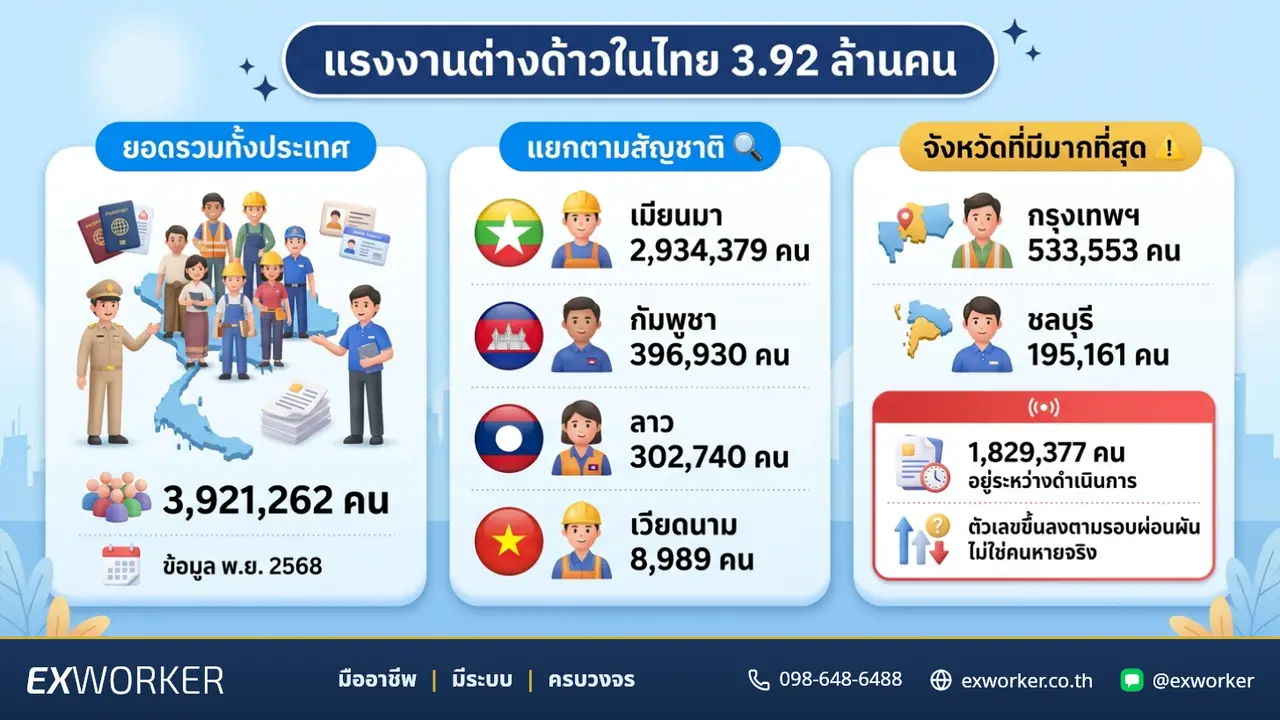
The latest data, for November 2025, shows 3,921,262 foreign nationals holding valid permission to work in Thailand. Of these, 3,643,038 — around 93% — are workers of the 4 nationalities (Myanmar, Cambodia, Laos, Vietnam).
But this data set needs to be read carefully. Between April and May 2025 the month-on-month figure fell by 1,907,266 in a single month. That does not mean nearly 2 million workers walked out of the country; it lines up with a change of registration group in the cabinet resolution cycle — and many news outlets still quote 2023 figures, or compare numbers taken from different bases.
This article separates, layer by layer, which number means "people with a work permit already in hand", which number means "people whose paperwork is still in process", and which set employers should use for workforce planning. Every figure on this page comes from one single source: the report on foreign nationals holding valid permission to work throughout the Kingdom, November 2025 edition, by the Office of Foreign Workers Administration, Department of Employment. No figures from other sources are mixed in.
To be upfront: this is data as of November 2025, not the current month. We checked on 26 August 2026 with the two units inside the Department of Employment that publish separate series — the Office of Foreign Workers Administration (monthly statistics on the work of foreign nationals) and the Labour Market Information Administration Division (data on the work of foreign nationals). Both stop at the November 2025 edition, while other statistics from the Department, such as provincial labour demand, are already published up to July 2026.
In other words, at the time of writing there is still no official 2026 migrant worker statistic to cite. If you find a site posting a specific "2026" figure without naming the month of the report, ask for the source before you believe it. This page will be updated as soon as the Department publishes a new edition.
Foreign nationals holding valid permission to work throughout the Kingdom: 3,921,262 · of whom the 4 nationalities make up 3,643,038 · and 1,829,377 of them are still in process, with no permit in hand yet.
Statistics on foreign nationals holding valid permission to work throughout the Kingdom, November 2025 edition · Office of Foreign Workers Administration, Department of EmploymentHow many migrant workers are there in Thailand? (November 2025 data)
The total is 3,921,262. This figure counts "foreign nationals holding valid permission to work", meaning people who were still inside the work permission system at the end of that month. It is not the total number of foreign nationals in the country, and it is not the number of people actually at work.
Broken down by the section of law under which permission was granted, it becomes clear that most of these people did not come in through an MOU, as many assume, but are the group granted the right to work under cabinet resolutions.
| Group (by section) | Number (persons) |
|---|---|
| Section 63/2, under cabinet resolutions | 2,985,155 |
| Section 59, imported under MOU | 640,560 |
| Section 59, general | 133,311 |
| Section 63/1, ethnic minorities | 85,887 |
| Section 62, investment promotion | 67,790 |
| Section 64, cross-border commuting or seasonal work | 8,561 |
| Total | 3,921,262 |
Note: the sum of the individual sections may differ slightly from the official total (by single digits) because of how the source report groups the data. We have not adjusted any figure ourselves.
The Section 63/2 group of almost 3 million splits further into two blocks: those registered from an unlawful status, 1,001,754, and those renewed under the cabinet resolutions of 24 September 2024 and 4 February 2025, another 1,983,399 — that second block is the heart of this article, and the next section explains why.
If it is still not clear how the cabinet resolution group differs from the MOU group, read more in how cabinet resolution workers differ from MOU workers, because the two groups have completely different rules for renewal and for changing employer.
The 4 nationalities: how many workers from each?
The 4 nationalities together total 3,643,038, and Myanmar is far ahead of the others.
| Nationality | Number (persons) |
|---|---|
| Myanmar | 2,934,379 |
| Cambodia | 396,930 |
| Laos | 302,740 |
| Vietnam | 8,989 |
| Total, 4 nationalities | 3,643,038 |
Myanmar workers number almost 2.94 million, several times more than Cambodia, Laos and Vietnam combined. For employers, this means that anything affecting Myanmar workers specifically — queues at CI document centres, or a renewal round — hits the overall workforce immediately. See the Myanmar document side in detail at CI for Myanmar workers: the 11 November 2025 cabinet resolution explained.
1.83 million people without a permit in hand — what employers need to know
This is the number almost nobody talks about. The 1,983,399 in the cabinet resolution renewal group splits into two statuses that mean entirely different things.
| Status | Number (persons) | What it means in practice |
|---|---|---|
| Permit issued (already received) | 154,022 | Holds the work permit in hand |
| Still in process | 1,829,377 | Application filed, permit not yet issued |
All 1,829,377 people in the "still in process" group are Myanmar nationals. Put simply: within the total of 3.92 million, almost 1.83 million have paperwork that is not finished.
Do not treat the 3.92 million total as "workers whose documents are complete and ready to work" — legally, what protects an employer is the document status of each individual employee, not an aggregate statistic. Always check your own employees one by one (see what happens when documents are incomplete at employing migrant workers illegally: what are the penalties).
Which group are your employees in — permit in hand, or among the 1.83 million still waiting? Statistics give you the big picture, but they cannot tell you what you still have to file. Ask Nong X, tell us the nationality and which cabinet resolution group your employee is in, and we will walk you through the steps that are left.
If your employees are in the cabinet resolution renewal group, follow the timeline and file every required document. Read the sequence of dates in the 11 November 2025 cabinet resolution timeline: what to file and when, and the document checklist at checklist for migrant workers in the cabinet resolution group. If you would rather not risk missing a renewal round, our work permit renewal service can handle it for you.
Why the provincial figure of 2.09 million does not match the 3.92 million total
If you open the provincial table and add it up yourself, you get 2,091,885, not 3,921,262. Many people assume they miscalculated, but the maths is right — the provincial database counts only people who already hold a work permit in hand. Those still in process are not yet recorded by province, because there is no permit yet on which to state a location.
How to choose the right figure for the job
- The 3,921,262 total — use it to answer "how many people are inside the work permission system", suitable for a policy-level overview.
- The 2,091,885 figure — use it to answer "where are the current permit holders located", suitable for planning your workforce in a specific area.
Another reason the sums do not tie out: the total for the 77 provinces excludes a further 24,953 applicants who filed centrally.
Which provinces have the most migrant workers? (Top 10)
The ranking below comes from the base of 2,091,885 work permit holders, as explained in the previous section.
The 10 provinces with the most migrant workers (Nov 2025)
Counting only those already holding a work permit; 2,091,885 nationwide
| Rank | Province | Number (persons) |
|---|---|---|
| 1 | Bangkok | 533,553 |
| 2 | Chonburi | 195,161 |
| 3 | Samut Prakan | 135,601 |
| 4 | Pathum Thani | 125,309 |
| 5 | Samut Sakhon | 107,012 |
| 6 | Rayong | 90,310 |
| 7 | Nonthaburi | 80,484 |
| 8 | Chiang Mai | 79,429 |
| 9 | Nakhon Pathom | 54,347 |
| 10 | Phuket | 53,570 |
The picture is one of concentration: Bangkok, its surrounding provinces, and the industrial areas of the Eastern Seaboard. Bangkok alone has more than ranks 2 to 4 combined. Phuket makes the top 10 even though it is not an industrial province, which reflects the service and tourism sector.
The mystery of the 1.9 million who vanished between April and May 2025
This is where this data set is most often misread. Look at the month-on-month figures across 13 consecutive months.
Foreign nationals granted permission to work, by month (Nov 2024 – Nov 2025)
Unit: millions of people · the gold column is the peak month, the dark orange column is the month the figure dropped
- 3.35
- 3.35
- 3.36
- 3.39
- 3.39
- 4.09
- 2.18
- 2.20
- 2.22
- 2.20
- 2.18
- 2.12
- 2.09
- Nov 24
- Dec
- Jan 25
- Feb
- Mar
- Apr
- May
- Jun
- Jul
- Aug
- Sep
- Oct
- Nov 25
| Month | Number (persons) | Change |
|---|---|---|
| Nov 2024 | 3,350,969 | — |
| Dec 2024 | 3,350,673 | Flat |
| Jan 2025 | 3,358,794 | Flat |
| Feb 2025 | 3,386,132 | Flat |
| Mar 2025 | 3,391,217 | Flat |
| Apr 2025 | 4,091,651 | +700,434 |
| May 2025 | 2,184,385 | −1,907,266 |
| Jun 2025 | 2,198,184 | Flat |
| Jul 2025 | 2,222,905 | Flat |
| Aug 2025 | 2,196,516 | Flat |
| Sep 2025 | 2,175,904 | Flat |
| Oct 2025 | 2,118,978 | Down |
| Nov 2025 | 2,091,885 | Down |
In April 2025 the figure jumped by 700,434 in a single month, then in May it fell by 1,907,266. Read superficially, you would conclude that "almost 2 million migrant workers disappeared", which is not true.
A falling number is not evidence that workers left the country — the explanation most consistent with the data is that this was the point where the amnesty group under the cabinet resolution of 7 February 2023 reached the end of its round, and the same people were moved into the newly registered group. In the overlapping month, two groups were counted at once (the spike), and then the old base dropped them the following month (the fall). This part is our own analysis, based on the shape of the numbers and the cabinet resolution timeline; it is not a statement written in the statistical report. See the sequence of the relevant resolutions in the cabinet resolution timeline.
What convinces us this is a counting matter rather than migration is that almost all of the decrease happened in the provinces, 1,902,500 people, while Bangkok fell by only 4,766. If workers had genuinely left the country, there is no way the largest labour market in Thailand would have barely moved.
For employers, the usable conclusion is this: never compare figures from before May 2025 directly with figures after it, because they are counted on different bases. Anyone drawing a graph straight across that point in a management report will get the whole slide wrong.
Bangkok fell 36.5% in one year — what does that mean?
The month-on-month comparison series for Bangkok shows 788,697 in November 2024 and 500,483 in November 2025, a fall of 36.5% over the year.
Read together with the previous section, it shows the same thing: the counting base changed; workers did not migrate out of the capital.
Transparency note: the Bangkok figure in the top 10 table (533,553) comes from the provincial table of the November 2025 edition, while 500,483 comes from the month-on-month comparison series. They are different data sets inside the same report, so the two numbers should not be subtracted from one another.
What work do migrant workers do most?
The report breaks occupations down by permission group, and the picture for each group is clearly different (counted as positions).
| Group | Most common occupations | Number (positions) |
|---|---|---|
| Under cabinet resolutions | Construction | 295,670 |
| General services | 131,396 | |
| Agriculture and livestock | 117,211 | |
| Imported under MOU | Food and beverages | 98,260 |
| Construction | 87,517 | |
| Agriculture-related processing | 76,585 | |
| General (Section 59) | Company managers, executives of private organisations | 71,921 |
| Teaching professions | 38,171 |
The last two rows are the part people forget — the general Section 59 group consists of foreign nationals at company manager level and teachers, not general labourers. The blanket assumption that "migrant worker = construction worker" does not match the data.
If your employee is doing work that does not match the type stated on the permit, fix it first. Read what is allowed and what is not at types of work for foreign nationals: permitted occupations and prohibitions, and if the job type genuinely has to change, use our job type change service.
The male-female split among migrant workers
Out of the base of 2,091,885 work permit holders, 1,194,104 are men and 897,781 are women — roughly 4 men for every 3 women, or about 33% more men.
One group runs the other way: Section 64 (cross-border commuting or seasonal work) has 4,974 women against 3,587 men. These are border workers who come in to work and then go back.
Common misunderstandings about this data set
- Many people think the 3.92 million total is every foreign national in Thailand. In fact it covers only those inside the work permission system; it excludes dependants, tourists and anyone who has not applied for permission to work.
- Many people think 1.9 million workers disappeared in one month. In fact that period coincides with a change of group in the cabinet resolution cycle; it is not evidence that people left the country.
- Many people think the provincial figures should add up to the national total. In fact the provincial base counts only permit holders, and excludes applicants who filed centrally.
- Many people think most workers came in through an MOU. In fact the MOU group is 640,560, while the cabinet resolution group is 2,985,155.
What should employers do with this data?
- Plan your workforce by area using the provincial base of 2,091,885, not the overall total, because it reflects people who are genuinely ready to work legally.
- Allow extra time for Myanmar workers' paperwork, because all 1,829,377 still in process are Myanmar nationals, so document work is more congested than usual right now.
- Do not draw a graph across April–May 2025 in year-on-year reports; always state that the counting base changed.
- Check each employee's documents individually. An aggregate statistic will not defend an employer who hires someone with incomplete paperwork.
If you are planning to add workers this year, the most stable route is still importing workers through the MOU system, because it does not depend on amnesty rounds that open and close with cabinet resolutions — weigh up the pros and cons first at MOU worker import: do it yourself or hire a company.
Frequently asked questions
How many migrant workers are there in Thailand in 2026?
The latest data published by the Department of Employment is for November 2025, at 3,921,262. A 2026 figure has to wait for a new edition of the report. If anyone quotes a specific 2026 number right now, ask for the source before believing it.
How many Myanmar workers are there in Thailand?
2,934,379 as of November 2025, the largest of the 4 nationalities and more than Cambodia, Laos and Vietnam combined.
Which province has the most migrant workers?
Bangkok, with 533,553, followed by Chonburi with 195,161 and Samut Prakan with 135,601 (counted from the base of work permit holders).
Why do news outlets report different numbers?
Mostly for three reasons: they use reports from different months, they use different bases (the overall total versus the provincial base), or they compare across the point in May 2025 where the counting base changed.
Is the number of migrant workers really falling?
In terms of the month-on-month series, yes, it fell. But the drop coincides exactly with the changeover of groups under the cabinet resolutions (this is our analysis, not an explanation given in the report), so it is not evidence that almost 2 million workers travelled out of the country.
How often is this data updated?
Normally it is published monthly, but as checked on 26 August 2026, both the Office of Foreign Workers Administration and the Labour Market Information Administration Division were still at the November 2025 edition. This page will be updated when there is a new edition that we have verified.
Sources
- Statistics on foreign nationals holding valid permission to work throughout the Kingdom, November 2025 edition — Office of Foreign Workers Administration, Department of Employment (every figure on this page comes from this single report)
- Data on the work of foreign nationals — Labour Market Information Administration Division, Department of Employment (used to confirm that the November 2025 edition is the latest; checked on 26 August 2026)
- The explanation of why the figure changed between April and May 2025 is Exworker's own analysis, based on the shape of the numbers and the cabinet resolution timeline; it does not appear as a statement in the statistical report
- To ask about an individual's document status: your local Provincial Employment Office, or the Department of Employment hotline 1694
Data updated: 26 August 2026 · The statistics are the November 2025 edition, the latest published by the Department of Employment (confirmed with both the Office of Foreign Workers Administration and the Labour Market Information Administration Division on 26 August 2026) · From Exworker's own document work for clients: the most frequent question about this data set is "why doesn't the national total match the provincial total", which is answered in section 4 above.


Comments
0 commentsNo comments yet
Leave a comment
Signed-in comments appear immediately — no review wait.
Every comment is reviewed before it appears.