
Migrant Worker Jobs in Thailand: Allowed and Prohibited
Which jobs migrant workers can do in Thailand and which are prohibited by law, with the legal basis, so you can employ without mistakes. By Exworker.
📋 Types of Work for Migrant Workers in Thailand: Requirements and Permitted/Prohibited Occupations
Thailand is one of the countries with a large number of migrant workers employed in various sectors, whether unskilled labor, semi-skilled labor, or specialized experts from around the world. However, the employment of migrant workers in Thailand is subject to clear laws and regulations to control and manage it in an orderly and fair manner for all parties: employers, employees, and Thai workers themselves. Understanding the types of work migrant workers can and cannot do is therefore extremely important for both employers and migrant workers themselves, to ensure that all procedures are carried out correctly according to the law and to avoid problems that may arise in the future.
✅ Laws and Regulations Related to the Employment of Migrant Workers
The employment of migrant workers in Thailand is governed by the Royal Ordinance on the Management of the Work of Migrant Workers B.E. 2560 (2017) and its amendments, as well as related ministerial regulations and announcements, which clearly define criteria, conditions, and types of work for migrant workers. The main objectives are to:
- ✅ Protect Thai workers' employment
- ✅ Promote the use of Thai workers in suitable positions
- ✅ Control and manage the work of migrant workers systematically
- ✅ Prevent human trafficking and illegal labor
Therefore, before employment or deciding to work in Thailand, migrant workers and employers should study this information thoroughly or consult migrant worker specialists like Exworker for accuracy and smoothness.
📌 Occupations Permitted for Migrant Workers in Thailand
Generally, occupations permitted for migrant workers are often those with a shortage of Thai workers, jobs requiring specialized skills that Thai workers do not yet sufficiently possess, or jobs exempted under international agreements. These can be divided into the following main categories:
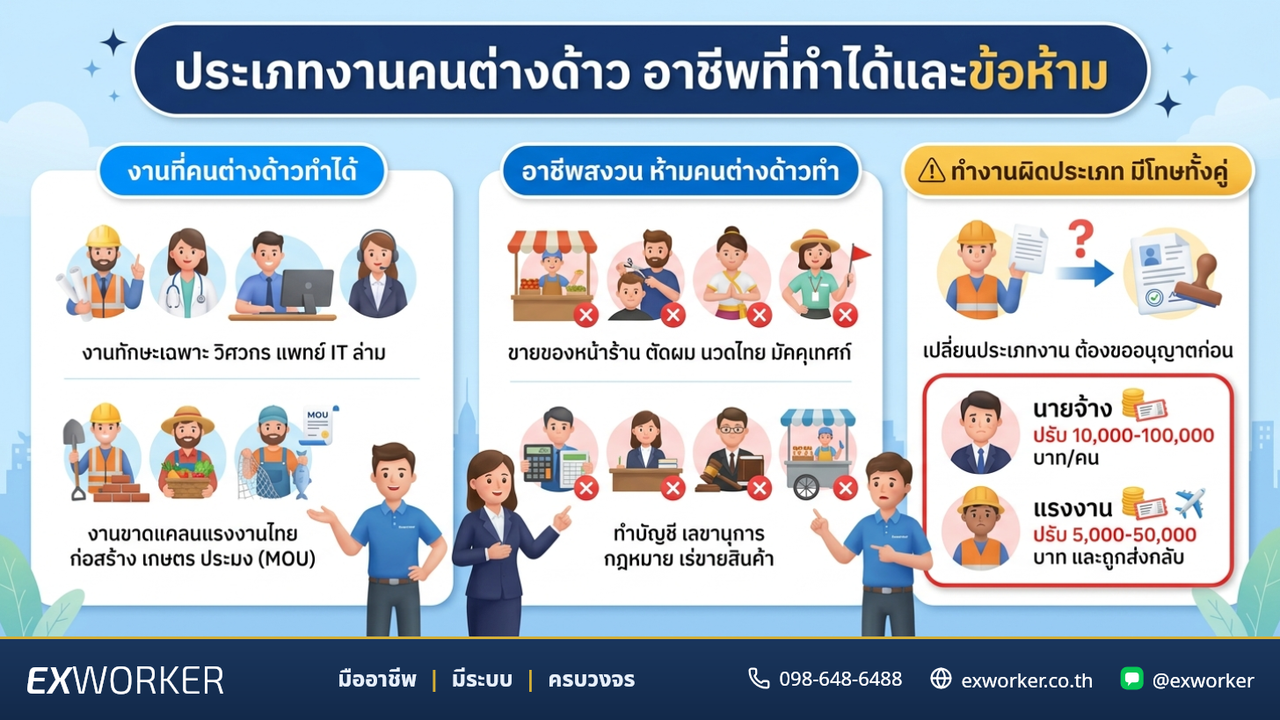
- 🔹 Work requiring specific skills, knowledge, or expertise: e.g., engineers, architects, doctors, researchers, university lecturers, pilots, IT specialists, interpreters, foreign cuisine chefs (in some cases)
- 🔹 High-level management and technical work: e.g., senior executives, project managers, organizational consultants with expertise in specific fields
- 🔹 Work with a genuine shortage of Thai workers: often in certain industrial sectors such as construction, agriculture, fisheries, domestic work (housekeepers), elderly or childcare, which are often MOU workers from neighboring countries (Myanmar, Laos, Cambodia)
- 🔹 Work in export businesses: work related to production for export, which may require a large workforce and specific demands
- 🔹 Work exempted by law or international agreements: e.g., work under the Eastern Economic Corridor (EEC) or certain Free Trade Agreements (FTAs)
These lists of occupations are not fixed and may change according to announcements from the Ministry of Labor, which will periodically consider the labor market situation and the country's needs.
❌ Occupations Prohibited for Migrant Workers in Thailand (Occupations Reserved for Thais)
To protect Thai workers and promote employment for Thais, the law has strictly prohibited migrant workers from engaging in certain occupations, known as "occupations reserved for Thais," which include:
- ❌ Laborer work (except work permitted under MOU or genuinely in short supply)
- ❌ Vehicle driving or car driving work other than forklift operation (except forklift driving in factories or international driving)
- ❌ Shop front sales work
- ❌ Haircutting, hairdressing, or beauty salon work
- ❌ Thai massage work
- ❌ Tour guide or tour operation work
- ❌ Hawking goods
- ❌ Accounting work
- ❌ Secretarial work
- ❌ Legal work
- ❌ Carpentry, masonry, and other construction work (except work requiring specialized skills that Thai workers lack)
- ❌ Agricultural work (except work permitted under MOU or genuinely in short supply)
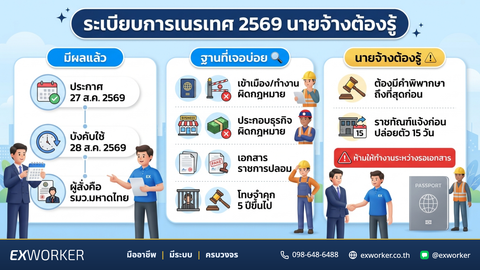
⚠️ Warning: Employing migrant workers in prohibited occupations, or migrant workers engaging in prohibited occupations, carries legal penalties for both employers and employees, which may lead to fines, imprisonment, or deportation. Therefore, strict adherence to the law is paramount.
💡 Special Cases and Considerations
In addition to the above list of occupations, there are special cases and further considerations related to the employment of migrant workers:
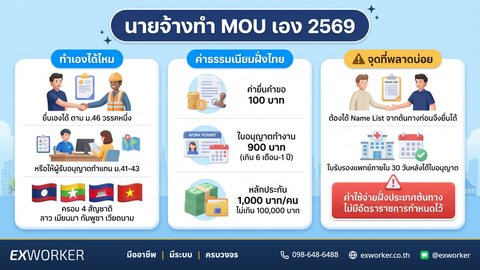
- 🔹 MOU Workers: Workers from neighboring countries (Myanmar, Laos, Cambodia) who enter to work under a Memorandum of Understanding (MOU) are often permitted to work in agriculture, construction, fisheries, and domestic work, which are jobs not favored by Thai workers.
- 🔹 Eastern Economic Corridor (EEC): In EEC areas, there may be special regulations that facilitate the employment of foreign experts and highly skilled workers to promote investment and technology development.
- 🔹 Change of Work Type: If a migrant worker wishes to change the type of work specified in their work permit, they must apply for a change with the Department of Employment first. Otherwise, it will be considered working in the wrong type of work and illegal.
- 🔹 Temporary Work: Temporary work, such as attending meetings, seminars, or being a speaker, may have different conditions and durations, and proper permission must be obtained.
🏢 Role of Employers and Entrepreneurs
Employers have an important duty to verify the qualifications of migrant workers and the type of work to be employed in accordance with the law, including correctly and promptly applying for a work permit and related documents. Failure to comply with the law may result in legal action against the employer, fines, and potentially a ban on employing migrant workers in the future.
💰 Penalties for Violations
Violations of the Royal Ordinance on the Management of the Work of Migrant Workers B.E. 2560 (2017) and its amendments carry penalties for both employers and migrant workers:
- ✅ Employer: If employing a migrant worker without a work permit, or employing them for work other than that specified in the permit, there may be a fine of 10,000 – 100,000 Baht per migrant worker. If the offense is repeated, there may be higher imprisonment and fines.
- ✅ Migrant Worker: If working without a work permit, or working other than that specified in the permit, there may be a fine of 5,000 – 50,000 Baht and potential deportation to the country of origin.
⚠️ Warning: Illegal employment of migrant workers not only creates legal risks but can also lead to human rights issues and human trafficking, which are issues of great importance to the Thai government.
Understanding and complying with laws related to the employment of migrant workers is extremely important for all parties. Whether you are an employer seeking migrant workers or a migrant worker wishing to work in Thailand, acting in accordance with the law will not only help avoid problems and penalties but also create a fair and sustainable working environment ✨ If you have any questions or require assistance with complex documentation and legal procedures, Exworker is pleased to offer consultation services and be a part of supporting legal employment in Thailand.
Comments
2 commentsงานขับรถส่งของ ต่างด้าวทำได้ไหมคะ อยู่ในอาชีพต้องห้ามหรือเปล่า
งานขับรถส่งของสำหรับคนต่างด้าวถือเป็นอาชีพที่ต้องห้ามค่ะ ❌ เว้นแต่งานขับรถยกในโรงงาน หรือขับรถระหว่างประเทศที่ได้รับอนุญาตเท่านั้นค่ะ
Answered by Exworker's AI assistant — please confirm with our team for your specific case.
Leave a comment
Signed-in comments appear immediately — no review wait.
Every comment is reviewed before it appears.