
Cabinet Resolution vs MOU Workers: What Is Different?
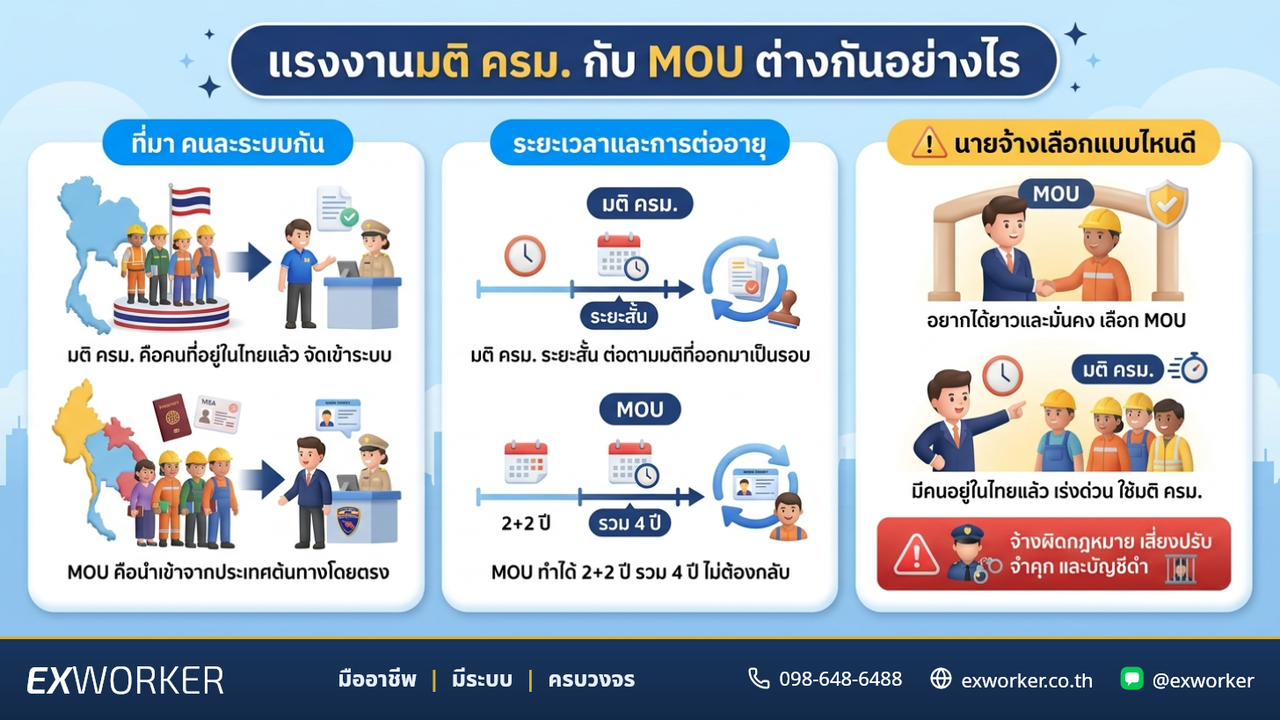
Cabinet resolution vs MOU migrant workers: legal basis, rights and limits compared, so employers can choose the right route. By Exworker.
🔍 The Difference Between Migrant Workers Registered Under Cabinet Resolution and MOU Migrant Workers: What Employers Should Know
In the world of migrant worker employment in Thailand, many employers may be confused about the types of migrant workers available, especially between “migrant workers registered under Cabinet Resolution (CR)” and “migrant workers under Memorandum of Understanding (MOU)”. These two types have completely different origins, processes, and requirements. Understanding these differences is crucial for employers to comply with the law correctly and choose the type of worker suitable for their business. This article from Exworker will take you deep into the details of both types of workers, so you can make decisions with confidence.
📋 What are Migrant Workers Registered Under Cabinet Resolution?
Migrant workers registered under Cabinet Resolution, or simply "CR migrant workers," are a group of migrant workers who are temporarily permitted to reside and work in the Kingdom, according to Cabinet resolutions issued periodically to address labor shortages or to regularize undocumented migrant workers into the system.
- ✅ Origin: Arises from the government's recognition of the necessity to grant leniency to migrant workers who do not yet have complete documents or are in an irregular legal status, allowing them to register and work legally for a certain period.
- 📌 Key Feature: A short to medium-term solution, often with a limited period of authorization, and requires periodic renewal according to future Cabinet resolutions.
- 💡 Target Group: Often workers who are already in Thailand but have not yet fully entered the system, or workers who wish to renew their work permit under special conditions.
🏢 What are MOU Migrant Workers?
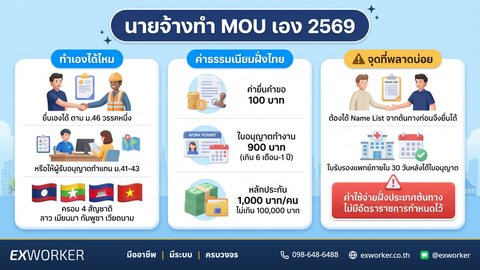
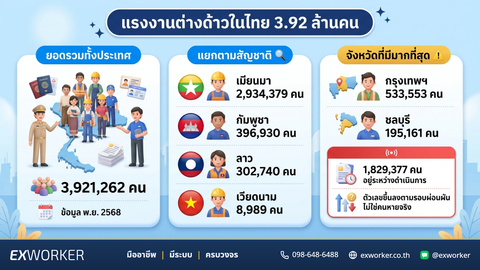
Migrant workers under Memorandum of Understanding, or "MOU migrant workers," are migrant workers who travel to work in Thailand under cooperation agreements between the Thai government and the government of their country of origin (e.g., Myanmar, Cambodia, Laos, and Vietnam) to establish a legal and standardized system for importing migrant workers.
- ✅ Origin: Arises from bilateral cooperation between countries to ensure that the employment process is transparent, standardized, and fair to both employers and employees.
- 📌 Key Feature: Involves direct import of workers from the country of origin, with clear and systematic processes, from selection, health check, visa application, and work permit application.
- 💡 Target Group: Workers who intend to travel to work in Thailand for the first time, or workers who wish to return to work after having returned to their country of origin.
📊 Key Differences Comparison Table
To provide a clearer picture, here is a table comparing the main differences between the two types of migrant workers:
| Feature | Migrant Workers Registered Under Cabinet Resolution | MOU Migrant Workers |
|---|---|---|
| Worker Origin | Mostly workers already in Thailand, who may have worked illegally or whose previous permit has expired. | Imported directly from the country of origin, under intergovernmental agreements. |
| Process | Depends on each Cabinet Resolution. Often involves leniency for in-country processing, including document submission, health checks, and work permit application. | Has clear and systematic steps, starting from the country of origin (selection, health check, document application) up to travel to Thailand and work permit application. |
| Permit Duration | Often short-term (e.g., 1-2 years) and requires waiting for renewal according to future Cabinet Resolutions. | Maximum work permit duration of 2 years, renewable for another 2 years (total 4 years) without needing to return to the country of origin. |
| Renewal | Primarily depends on Cabinet Resolutions. May be renewed multiple times if supported by a resolution. | Generally renewable once (total 4 years), after which workers must return to their country of origin before re-entering under the MOU system. However, in the past, there have been several Cabinet Resolutions granting leniency for MOU migrant workers who have completed 4 years to stay and continue working without returning to their country of origin (e.g., Cabinet Resolution of March 15, 2022, allowing an extension of no more than 2 years). Such leniency has its own expiry date, so the latest resolution must be checked before planning every time. |
| Key Documents | Identification documents issued by Thai authorities (e.g., ID card for persons without Thai nationality) or documents from the country of origin that have been granted leniency. | Passport or Travel Document issued by the country of origin. |
| Flexibility/Employer Change | Changing employers is more flexible than for the MOU group, as it follows the criteria of the registered resolution round and is not bound by the conditions of Section 51. Check with the provincial employment office in the area. | If leaving work before contract completion, must meet the conditions under Section 51, which means proving to the registrar that the departure was due to the employer's fault, or that compensation has been paid to the former employer (details of what constitutes "employer's fault" are at the discretion of the registrar according to the Department of Employment's guidelines). And must start working with a new employer within 30 days from the date of termination with the former employer, as per Section 52. |
| Costs | May fluctuate, depending on fees and processing costs according to Cabinet Resolutions. | Has relatively fixed and systematic costs, both in the country of origin and in Thailand. |
| Risk to Employers | May have long-term uncertainty if no Cabinet Resolution is issued to support renewal. | Has a clear and transparent system, reducing the risk of employing undocumented workers if procedures are followed. |
Because these two groups use different sets of criteria, the first thing to do before transferring an employee is to check which group they belong to and if they are actually eligible for transfer. You can find the procedures and documents for both MOU and pink card groups at Migrant Worker Employer Change Service
🔄 Can Cabinet Resolution Migrant Workers Change to MOU Migrant Workers?
The answer in principle is that these two groups of migrant workers are in different systems and therefore cannot switch between themselves. Entering the MOU system requires starting a new import process from the country of origin (Submit Demand → Country of origin selection → Visa and Work Permit application), which typically requires the worker to return to the country of origin for processing first.
Important exception: In several past rounds, Cabinet Resolutions have opened channels for certain steps to be processed in Thailand. These are open for limited periods and have specific group conditions. Before deciding to send an employee back, you should check with the provincial employment office whether there is an in-country processing channel available in the current round, as sending back and re-importing incurs costs and takes several months.
💡 Considerations for Employers
- 🔹 Short-term or Long-term Needs: If long-term and stable workers are required, MOU migrant workers are often the better choice.
- 🔹 Budget: The initial costs for MOU migrant workers may be higher, but they offer more certainty in the long run.
- 🔹 Urgency: If workers are urgently needed and are already in the country, registration under Cabinet Resolution may be a faster solution in some cases.
- 🔹 Process Complexity: The MOU process is more complex and time-consuming, but it is clear and standardized.
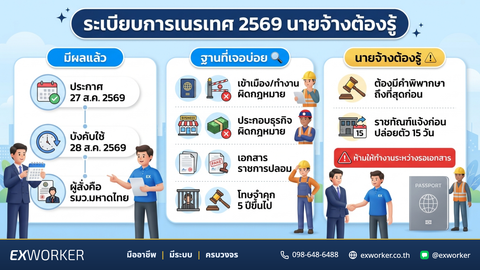
⚠️ Warning: Employing migrant workers without complying with the law, regardless of the worker type, is an illegal act and carries severe penalties, including fines and imprisonment, as well as being blacklisted from employing migrant workers in the future. Employers should always study the information and proceed carefully.
It is evident that migrant workers registered under Cabinet Resolution and MOU migrant workers differ significantly in many dimensions. Understanding these differences will help employers plan their employment effectively, reduce legal risks, and ensure that their business operates smoothly. If any employer still has questions or requires assistance with migrant worker procedures, Exworker is ready to be a professional consultant and service provider, to ensure that all steps are correct and compliant with the law.
Choosing the correct type of migrant worker not only helps your business comply with the law but also helps you acquire quality workers suitable for your organization's needs.
Comments
2 commentsแรงงานมติ ครม. กับแรงงาน MOU ต่างกันตรงไหนครับ เปลี่ยนจากมติ ครม. เป็น MOU ได้ไหม
แรงงานมติ ครม. ส่วนใหญ่เป็นแรงงานที่อยู่ในประเทศไทยอยู่แล้ว ส่วนแรงงาน MOU เป็นการนำเข้าจากประเทศต้นทางโดยตรงค่ะ การเปลี่ยนจากแรงงานมติ ครม. เป็น MOU โดยหลักการแล้วไม่สามารถเปลี่ยนข้ามระบบกันได้ค่ะ การเข้าสู่ระบบ MOU ต้องเริ่มกระบวนการนำเข้าใหม่จากประเทศต้นทางค่ะ
Answered by Exworker's AI assistant — please confirm with our team for your specific case.
Leave a comment
Signed-in comments appear immediately — no review wait.
Every comment is reviewed before it appears.