
Re-Entry Permit: Return to Thailand Without Starting Over
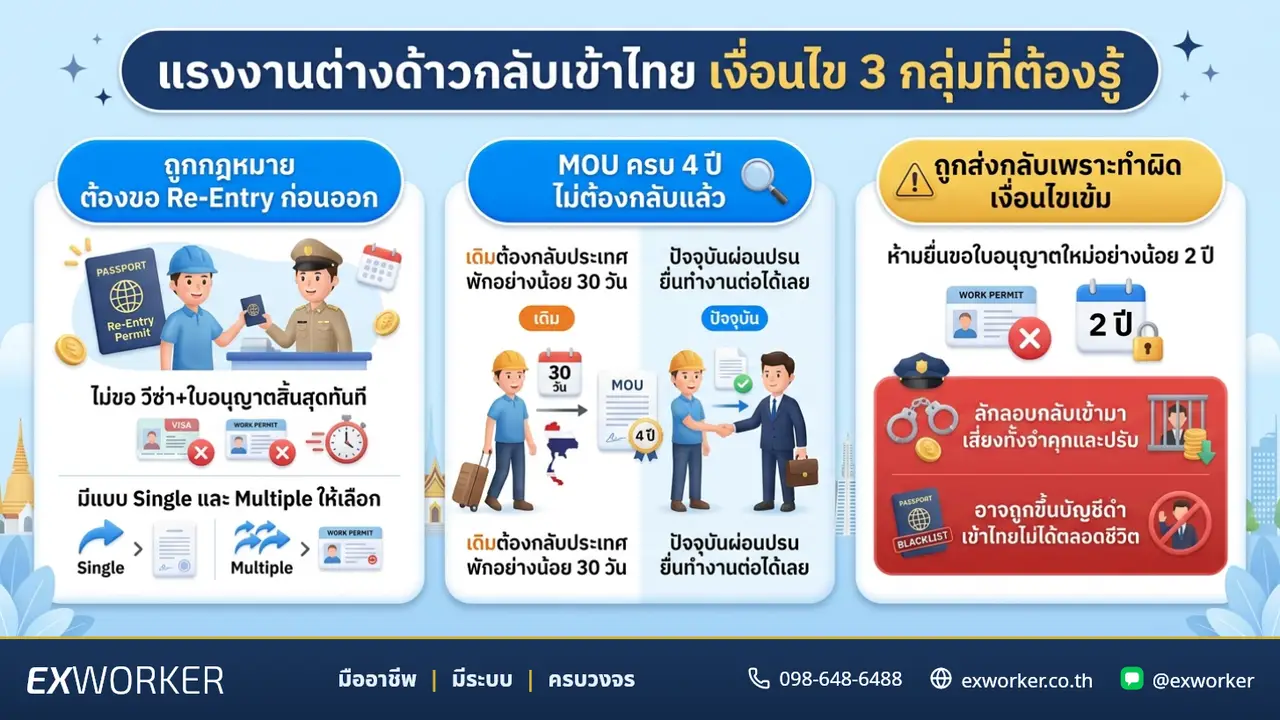
Guide for employers and migrant workers re-entering Thailand after a trip home: the Re-Entry Permit, MOU and how Exworker can help.
📌 Re-entry of migrant workers into Thailand: What you need to know after returning to your home country
For employers and migrant workers in Thailand, returning to their home country, whether for family visits or at the end of a contract term, is a common occurrence. Equally important is understanding the conditions and procedures for re-entering Thailand for work, to ensure the process is smooth, uninterrupted, and most importantly, legally compliant. This article from Exworker will delve into all the conditions migrant workers and employers should know to avoid potential problems in the future.
✅ Group 1: Migrant workers legally authorized to work
This group consists of migrant workers who possess a VISA and work permit that are fully compliant with the law, whether they are skilled workers or general laborers who have entered the country through proper channels. If they wish to travel back to their home country temporarily, the most crucial thing to prioritize is "requesting a Re-Entry Permit" or applying for permission to re-enter the Kingdom.
💡 Importance of Re-Entry Permit (Permission to re-enter the Kingdom)
A Re-Entry Permit is a crucial document that helps preserve a migrant worker's right to reside and work in Thailand, preventing it from expiring. If a worker travels outside the country without applying for a Re-Entry Permit beforehand, their existing VISA and work permit will immediately expire. When they wish to return to work, they will have to restart the entire process of importing new workers, which involves complicated, complex, and time-consuming procedures.
- ✅ Benefits of having a Re-Entry Permit:
- 🔹 Preserves the status of the VISA and work permit, preventing their expiration.
- 🔹 Allows re-entry into Thailand within the specified period without needing a new VISA.
- 🔹 Saves time and costs associated with initiating a new worker import process.
- ❌ Disadvantages of not having a Re-Entry Permit:
- 🔹 The VISA and work permit will be automatically cancelled upon departure from the country.
- 🔹 The entire process of applying for a new VISA and work permit must be restarted as if they were a new worker.
- 🔹 May impact the employer's work plans and business.
Applying for a Re-Entry Permit can be done at the nearest immigration office or at the airport before departing the country. Options include Single Re-Entry (for a single return) and Multiple Re-Entry (for multiple returns within the validity period of the VISA).
📋 Group 2: Migrant workers who entered under the MOU (Memorandum of Understanding) system
This group of workers typically includes those in manufacturing, agriculture, or services, who entered to work under agreements between the Thai government and the governments of their home countries, such as Myanmar, Cambodia, Laos, and Vietnam. Normally, these workers have employment contracts and work permits for a specified duration, mostly for 4 years.
📅 Normal regulations upon completion of the 4-year contract term
According to previous practices, when MOU workers completed their 4-year employment contract, they were required to return to their home country and rest for at least 30 days before they could proceed to re-enter Thailand for work. This process was intended for workers to rest and visit their families, but in practice, it often caused inconvenience for both employers, who had to find replacement workers, and the workers themselves, who incurred travel time and expenses.
💡 Exceptions and current practices: No need to return, no need to wait
Given the current situation and demand for labor, the Thai government has implemented relaxed policies and exceptions for MOU workers, especially in recent times. This allows MOU workers to apply for continued employment directly, without needing to return to their home country and without the requirement to rest for 30 days anymore.
- ✅ Benefits of this exception:
- 🔹 Employers avoid labor shortages: They can retain skilled personnel familiar with the work.
- 🔹 Workers save time and expenses: No need to travel back to their home country and rest.
- 🔹 Continuous process: The renewal of work permits and continued stay in the country proceeds more smoothly.
- 📌 Things to know: Utilizing this exception involves specific procedures and required documents, which may change according to announcements from relevant government agencies. Consulting a migrant worker expert like Exworker will help employers and workers proceed correctly and quickly.
⚠️ Group 3: Migrant workers deported due to committing an offense
This is a group that requires special attention and should be avoided as much as possible. Migrant workers who are deported to their home country due to committing an offense under Thai law will face strict conditions and restrictions on re-entering Thailand for work.
❌ Consequences of violating the law
Common offenses include:
- 🔹 Illegally entering the Kingdom without permission
- 🔹 Working without a valid work permit
- 🔹 Working in a different type of job than specified in the work permit
- 🔹 Overstaying in the Kingdom
- 🔹 Involvement in other criminal offenses
If a migrant worker is arrested and found to have committed these offenses, they will be subject to legal fines, deported to their home country, and importantly, will be prohibited from applying for a new work permit for a period of at least 2 years. This means they cannot legally re-enter Thailand for work during that time.
⚠️ Caution: Illegal re-entry is strictly prohibitedFor workers who have been deported due to committing an offense and are currently prohibited from re-entering Thailand for work, attempting to illegally re-enter the Kingdom, whether by crossing the border on foot or through other channels, will lead to even more severe penalties, including imprisonment, fines, and strict legal prosecution. Furthermore, they may be blacklisted, preventing them from ever traveling to Thailand again.
🏢 Exworker's Role in Assisting You
Managing migrant worker matters is complex and regulations are constantly changing. Understanding and strictly adhering to the law is crucial to avoid undesirable problems and consequences. Exworker is ready to be your consultant and assistant in all types of migrant worker procedures, whether it's applying for a Re-Entry Permit, renewing a work permit, processing under the MOU system, or providing advice on relevant laws and regulations. We are prepared to serve with expertise and experience, so that both employers and migrant workers can conduct business and live in Thailand correctly and with peace of mind.
📝 Summary: Plan Carefully for a Secure Future
Whether you are an employer managing migrant workers or a worker yourself, having knowledge and understanding of the conditions for re-entering Thailand for work after returning to your home country is extremely important. Planning ahead, preparing documents, and consulting experts will help ensure all processes are smooth, safe, and legally compliant, for a secure future for everyone.
Comments
2 commentsลูกจ้างจะกลับบ้านช่วงสงกรานต์ ต้องทำ Re-Entry Permit ก่อนออกใช่ไหมครับ ค่าธรรมเนียมเท่าไหร่
ใช่ค่ะ ลูกจ้างต้องทำ Re-Entry Permit ก่อนเดินทางออกนอกประเทศ เพื่อรักษาสิทธิการอยู่อาศัยและใบอนุญาตทำงานไม่ให้สิ้นสุดลงค่ะ 😊 สำหรับค่าธรรมเนียม Re-Entry Permit จะมีดังนี้ค่ะ: - แบบ Single Re-Entry (กลับเข้ามาครั้งเดียว): 1,000 บาท - แบบ Multiple Re-Entry (กลับเข้ามาได้หลายครั้ง): 3,800 บาท ค่าธรรมเนียมนี้เป็นค่าธรรมเนียมที่ต้องชำระที่สำนักงานตรวจคนเข้าเมืองโดยตรงเลยนะคะ
Answered by Exworker's AI assistant — please confirm with our team for your specific case.
Leave a comment
Signed-in comments appear immediately — no review wait.
Every comment is reviewed before it appears.