
Notify Entry & Exit of Foreign Workers: BT.52/53 & the 15-Day Rule
An employer guide to notifying the registrar when you hire or a foreign worker leaves: the deadline, how to count the days, which form to use, the penalty, and how it differs from TM.30.
When you take on a foreign worker, or an employee resigns or is dismissed, the employer always has a legal "duty to notify" the registrar. It does not end the moment the employment contract is signed or terminated, and this duty has a deadline that carries a real fine if you miss it.
This article explains three key points for employers and HR: how many days you have to notify, how the time is counted, and which form to use. It also makes clear that this is not the same as the residence notification (TM.30) or the 90-day report, which are frequently confused.
30-second summary
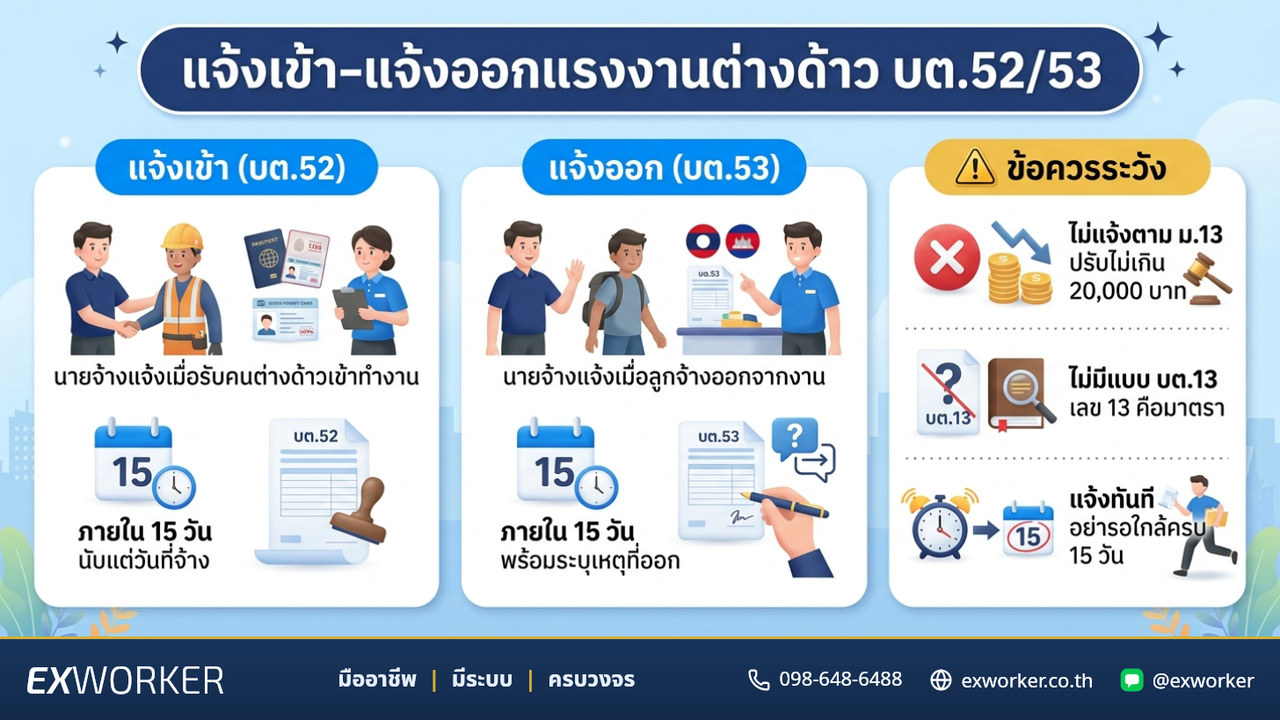
- Notify entry (taking someone on) and notify exit (leaving the job) must both be reported to the registrar within 15 days.
- Use form BT.52 for notifying entry and BT.53 for notifying exit — there is no "form BT.13" (13 is a section number, not a form number).
- Failure to notify: a fine of up to 20,000 baht under Section 103.
- Changing employer: the former employer notifies the exit, the new employer notifies the entry. The new employer does not have to wait for an "exit notification slip" from the old workplace.
What is "notify entry / notify exit", and how is it different from changing employer?
Notifying entry and exit is when the employer reports the facts to the registrar (the Department of Employment) that a foreign national has been taken on, or has left the job. It is a duty under Section 13 of the Royal Ordinance on the Management of Foreign Workers' Employment B.E. 2560 (amended by the second edition, B.E. 2561).
People often confuse this with "changing employer", but they are separate matters:
- Changing employer = the process of moving an employee from an old workplace to a new one correctly (with conditions and a time frame for starting at the new workplace). Read more at Change of employer service for foreign workers and the article Changing a foreign worker's employer online: who is eligible.
- Notify entry / exit = informing the authorities that an employment has started or ended. It is a separate step, and it is required even for ordinary hiring that does not involve moving from anywhere.
Which form to use — BT.52, BT.53 (not "BT.13")
The most common mistake is calling the form "BT.13", which does not exist — the number 13 refers to "Section 13", the legal basis of the duty, not the name of a form. The actual forms from the Department of Employment are as follows.
BT.52 — Notify entry
Form to notify the employment of a foreign national (Section 13, first paragraph). The employer uses it to report that a foreign national has been taken on.
BT.53 — Notify exit
Form to notify that a foreign national has left the job. The employer uses it when a foreign employee's employment ends, and must state the reason for leaving.
BT.55 — The worker notifies personally
Form for a foreign national to notify their own start of work (Section 64/2). This is the duty of "the employee" themselves, not the employer.
An easy way to remember: 52 for entry, 53 for exit. BT.55 is the duty of the foreign national, who must notify it themselves within 15 days each time they start work or change employer.
How many days do you have to notify?
The law sets a clear time frame for both entry and exit.
- Notify entry: within 15 days from the date of hiring.
- Notify exit: within 15 days from the date the foreign national leaves the job, and you must also state the reason for leaving.
Notifying entry/exit must be reported to the registrar within 15 days from the date of hiring, or the date the foreign national leaves the job.
Royal Ordinance on the Management of Foreign Workers' Employment B.E. 2560 (amended by the 2nd edition, B.E. 2561), Section 13How to count the 15 days
The legal text uses the words "from the date of hiring" and "from the date the foreign national leaves the job", meaning the count starts on the date the event occurs — the start date of employment, or the date the employee leaves the job.
As for the question of "whether the first day is included or the count starts the next day", this Royal Ordinance does not specify, so it can be interpreted in more than one way. If you need certainty for a case that is close to the deadline, confirm the practice with your local provincial employment office or the 1694 hotline first.
The safest approach is not to wait until the 15 days are nearly up — notify as soon as possible after the employee starts or leaves, because notifying early carries no penalty while notifying late does. This approach is safe no matter how the day count is interpreted.
If an employee simply disappears from work without formally resigning, notify as soon as you are sure they will not return; there is no need to wait for any deadline.
Changing employer: who notifies exit, who notifies entry
Cases of moving an employee from a former employer to a new one are a common point of confusion over who has to do what. In short:
- The former employer has the duty to notify exit (BT.53) within 15 days. This is the former employer's duty, not the employee's or the new employer's.
- The new employer has the duty to notify entry (BT.52) within 15 days from the date of hiring.
- The foreign national themselves must notify BT.55 within 15 days each time they change employer.
Key point: the new employer does not have to wait for an "exit notification slip" from the former employer in order to take the employee on. Demanding documents beyond what the law requires is an improper use of authority. If you run into this problem, see details in the article A foreign worker resigns after the employer paid for documents: what to do.
Note that "the time frame within which the employee must start work with the new employer" is a separate matter from notification and has its own conditions. Read more at Changing a foreign worker's employer online: who is eligible.
MOU workers: the separate 7-day deadline
For workers imported under the MOU system, there is a specific provision under Section 50 that sets a shorter time frame — within 7 days — when the following occur.
- The employer does not take the foreign national on.
- The foreign national does not consent to work.
- The foreign national leaves the job for any reason.
In these cases you must notify both the licensee who brought the foreign national to work and the registrar, using form BT.53 (leaving the job) or BT.54 (not taken on / not consenting to work). If this is hiring through an MOU, see the overall process at MOU foreign worker import service and 6 steps to importing MOU workers that employers should know.
Where to notify
You can notify through the e-WorkPermit system (eworkpermit.doe.go.th) or at the provincial/area employment office where the workplace is located.
Note that the online channel may not support every form or every worker group equally, so you should check which channel supports your worker group with the office before proceeding. If you have trouble using the e-WorkPermit system, see e-WorkPermit for foreign workers: common problems and how to fix them.
Documents to prepare
Prepare the information required by the form — that is, form BT.52 (notify entry) or BT.53 (notify exit), together with the employer's and employee's details. For an exit notification you must also state the reason for leaving the job.
The exact list of supporting documents may differ by worker group and by the channel used, so you should confirm with your local employment office or the 1694 hotline before preparing documents, to avoid having to redo the process.
What is the penalty for not notifying?
Failing to notify under Section 13, whether entry or exit, carries a penalty under the law.
Failing to notify entry/exit within 15 days: a fine of up to 20,000 baht under Section 103 (a fine-only penalty, which can be settled by way of a compounded fine under Section 133 — that is, paid without going to court).
Similarly, if the foreign national themselves fails to notify BT.55 under Section 64/2, they too face a fine of up to 20,000 baht (Section 119/1). For an overview of employer penalties, see Hiring foreign workers illegally: how much is the fine, with the sections cited.
Don't confuse them: notify entry/exit is not TM.30 and not the 90-day report
These three are different laws, different agencies, and different forms, but they are very often mixed up.
| Matter | Whose duty | Filed with | What it is |
|---|---|---|---|
| Notify entry/exit (BT.52/53) | Employer | Department of Employment | Notifying the start/end of employment (Section 13) |
| Residence notification (TM.30) | Householder / property owner | Immigration Bureau | Notifying that a foreign national is staying (Immigration Act) |
| 90-day report | The foreign national | Immigration Bureau | Reporting address every 90 days |
Details on the latter two are at Residence notification for foreign workers under Section 38 within 24 hours and The 90-day report for foreign workers: is the fine real?.
Things you must not misunderstand
- "Fill in form BT.13" — no such form exists; 13 is a section number. The real forms are BT.52 (entry) / BT.53 (exit).
- "I filed TM.30, so I've done the entry/exit notification" — different matters, different agencies; you must do both.
- "The employee has run off, so I don't have to notify" — you must always notify the exit; not notifying is the employer's offence.
- "I must wait for the exit slip from the old workplace before I can take them on" — no need to wait; the new employer can notify entry straight away.
Checklist for employers
- Take on an employee → notify entry (BT.52) within 15 days from the date of hiring.
- Employee resigns / is dismissed / disappears → notify exit (BT.53) within 15 days, stating the reason.
- MOU worker falling under Section 50 → use the 7-day deadline, notifying both the licensee and the registrar.
- Remind the employee to notify their own BT.55 within 15 days too.
- Unsure of the channel/documents → call the employment office or the 1694 hotline first.
- Don't wait until the deadline is near — notifying early carries no penalty.
Frequently asked questions
What is the difference between BT.13 and BT.52?
There is no "form BT.13". The number 13 is Section 13, the legal basis of the duty to notify. The actual forms are BT.52 (notify entry) and BT.53 (notify exit).
What if I notify more than 15 days late?
Notify immediately; even past the deadline you must still notify. The penalty is a fine of up to 20,000 baht under Section 103, which can be settled as a compounded fine — ignoring it is not the end of the matter.
An employee ran off and disappeared — do I still have to notify the exit?
Yes. Notify the exit as soon as you are sure the employee will not return, and state the reason truthfully.
Does the new employer have to wait for the exit slip from the old workplace?
No. The new employer can notify entry (BT.52) within 15 days from the date of hiring. Requiring an exit slip as a condition is demanding documents beyond the law.
Is there a fee for notifying entry/exit?
Confirm the fee rate (if any) with your local employment office or the 1694 hotline before proceeding, as it depends on the worker group and the channel used.
References
- Royal Ordinance on the Management of Foreign Workers' Employment B.E. 2560, amended by (No. 2) B.E. 2561 — Sections 13, 50, 64/2, 103, 119/1, 133 (Government Gazette, Vol. 135, Part 19 Kor, 27 March 2018).
- Download page for forms BT.52/BT.53/BT.55, Office of Foreign Workers Administration, Department of Employment (doe.go.th).
- e-WorkPermit system, Department of Employment (eworkpermit.doe.go.th) · Hotline 1694.
Updated: 25 August 2026 (B.E. 2569) · Legal information may change; you should check with your local employment office before proceeding.
Comments
0 commentsNo comments yet
Leave a comment
Signed-in comments appear immediately — no review wait.
Every comment is reviewed before it appears.