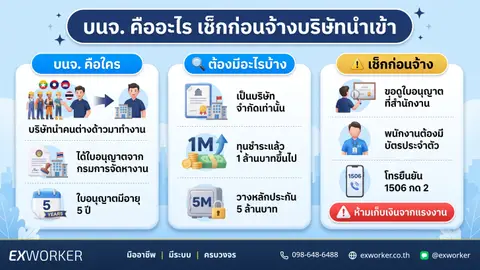
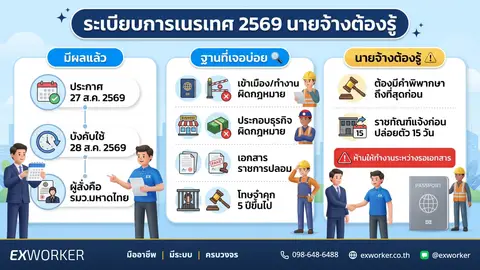
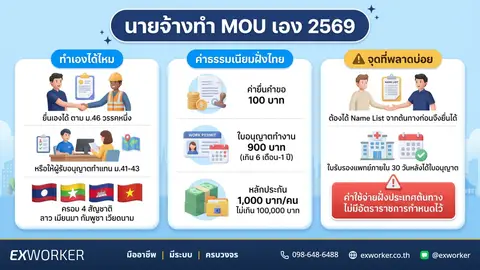
MOU Migrant Worker Import from Laos & Myanmar | Exworker
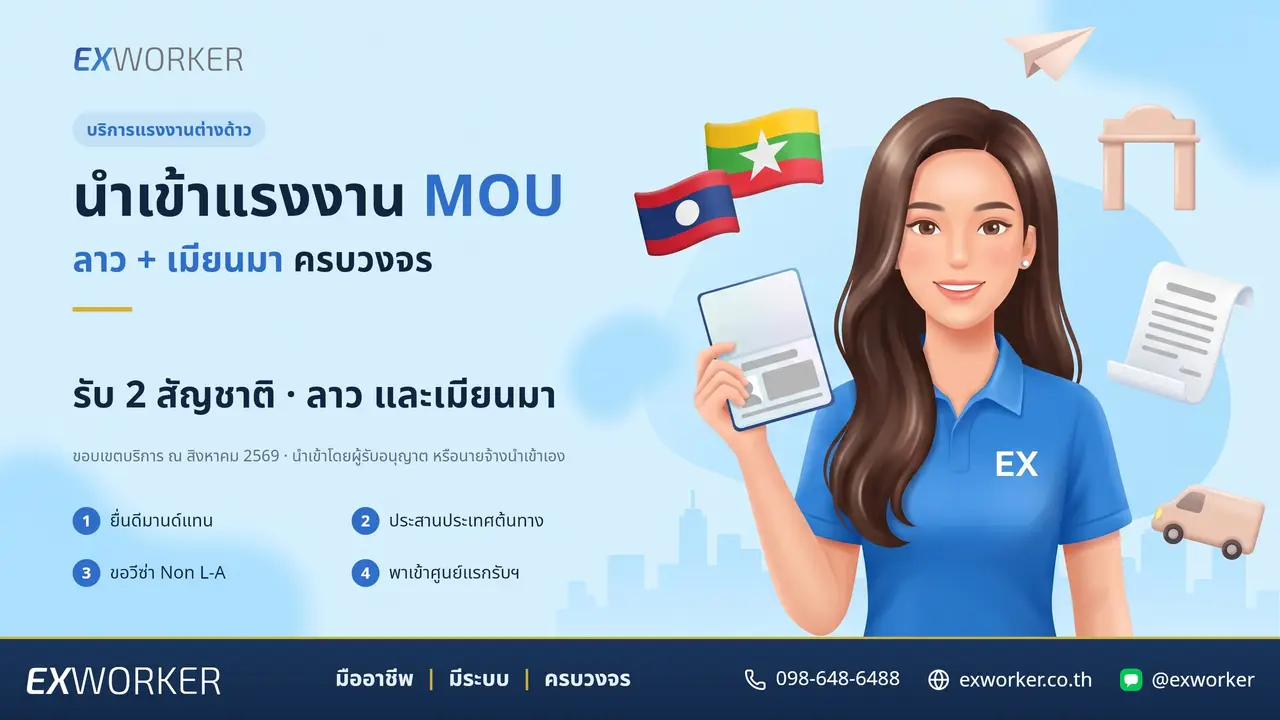
MOU for Lao and Myanmar workers, handled end to end: demand filing, source-country liaison, first-entry centre and work permit — plus how the two differ.
- Foreign worker import licence no. Nor.Jor. 0122/2561
- 5,000+ cases for 500+ companies
MOU (a Memorandum of Understanding between the Thai government and the government of the source country) is the legal channel for hiring migrant workers that employers can actually use — both for people still abroad and for people already in Thailand. Unlike the temporary relief granted under cabinet resolutions, MOU is a permanent system written into law: there is no need to wait for a resolution round to open.
Exworker handles MOU for Lao and Myanmar nationals, from filing the import request (Demand) with the Department of Employment, liaising with the authorities in the source country, arranging worker selection, handling the visa, escorting workers through the First-Entry and Employment Termination Centre (ศูนย์แรกรับเข้าทำงานและสิ้นสุดการจ้าง), through to collecting the work permit and delivering the worker to your premises. Employers do not have to run the paperwork in either country themselves.
Which track is your case on — pick one before reading further
MOU work splits into 2 tracks that use completely different documents and timelines. Spend 10 seconds on this table, then skip straight to your own track.
| If your situation is… | The track you use |
|---|---|
| You have no workers yet and need new people from Lao PDR or Myanmar to come and work | Track A — importing new workers |
| You already have Lao or Myanmar workers inside Thailand and want to bring them into the MOU system with your business, properly | Track B — workers already in the country |
| Your employee is already an MOU worker and simply needs to move to a new employer | Not a new MOU job → see change of employer service for migrant workers |
Service scope as of August 2026: Thailand's MOU system covers 4 nationalities — Cambodia, Laos, Myanmar and Vietnam. Exworker handles 2 of them, Lao and Myanmar, on both tracks above. If your employee holds another nationality, we can still look at the other services we do offer, such as the pink card or Myanmar worker identity documents.
Not sure which track your case falls under? Talk to Nong Ex (our AI assistant) any time, 24 hours a day. Just say what nationality the worker is, where they are, and what documents they are holding, and Nong Ex will tell you which track to take. If the case is complicated, it gets passed to a real member of the team.
What is the difference between Lao MOU and Myanmar MOU?
The short answer is that the Thai side is identical — the same law, the same set of forms (บต.31, บต.46, บต.42) and the same schedule of government fees, because the Department of Employment uses a single public service manual covering all 4 nationalities. There are only 2 genuine differences: where the visa is issued and which First-Entry and Employment Termination Centre the worker attends for the briefing and to receive the work permit.
Lao nationals
Visa: the Department of Employment writes to the Royal Thai Embassy in the source country, and the worker is issued the visa (Non-Immigrant L-A) there before travelling to Thailand.
First-Entry Centre: Mukdahan and Nong Khai provinces.
Myanmar nationals
Visa: the Department of Employment writes to the Embassy of Myanmar in Thailand, and the worker is issued the visa at the immigration checkpoint before entering the country.
First-Entry Centre: Tak and Ranong provinces.
The first-entry centre locations and visa channels are current as of August 2026 and follow the Department of Employment's public service manual. The visa point for Myanmar nationals is the single thing employers most often get wrong — many believe the worker has to obtain a visa in Yangon first, when the actual procedure runs through the Myanmar Embassy in Thailand and the visa is then issued at the checkpoint.
Everything else — the documents and procedures on the source-country side — follows the rules of Lao PDR and the Republic of the Union of Myanmar, which can change without any Thai announcement. Exworker coordinates this for every case and tells you each time the source-country side changes its conditions.
The problems employers run into most often with MOU
- Planning too late — MOU is not a service where you order today and get people tomorrow. Employers who wait until the order is confirmed before starting usually miss their production window.
- Filing the demand and then hearing nothing — no idea which step the file is stuck at, whether on the Thai side or the source-country side, and nobody chasing it.
- Employer documents that do not support the headcount requested — asking for more people than the business evidence justifies, getting the file returned for correction, and losing another round of time.
- Names, spellings and passport numbers that do not match between the Thai documents and the source-country documents — one mismatch is enough to stall the file, and it happens more often with Myanmar documents because a name can be romanised in several different ways.
- Workers arrive but the paperwork is not finished — employers assume that getting the worker to the factory means the job is done, when several legally required steps remain, each with its own deadline and its own fine.
- The worker disappears after delivery — nobody knows who has to be notified, within how many days, or who carries the costs that follow.
Track A: importing new migrant workers from Laos or Myanmar
This applies to employers who need additional workers, selecting them in the source country and importing them through the system. The law provides 2 routes: having a licensed importer of foreign nationals carry out the process (Sections 41–43), which is the licence our company holds, or the employer doing it themselves (Section 46). These two groups are what the statute calls "foreign nationals working for an employer under Section 43 or Section 46", and that phrase is the source of the rights and duties set out in Sections 50–55 below.
The main steps
| Step | What happens | Who does it |
|---|---|---|
| 1. File the import request (Demand) | Notify the Department of Employment how many workers you want to hire, of what nationality and in what positions, together with evidence that the business needs them | We file on your behalf (the employer signs) |
| 2. Send the request to the source country | The file is sent through official channels to the employment authority in Lao PDR or Myanmar | We coordinate |
| 3. Worker selection | The source-country team selects people against the criteria the employer specified, checks their background, and prepares the Name List certified by the source country | Our partner team in the source country |
| 4. Apply for work permits on behalf of the foreign nationals | Submit the original Name List with the application (บต.31) and the employment certification letter (บต.46) to the employment office covering the area where the workplace is located, and pay the application fee and the work permit fee | We handle it |
| 5. Non-Immigrant L-A visa issuance | Laos = at the Royal Thai Embassy in the source country · Myanmar = through the Embassy of Myanmar in Thailand, with the visa then issued at the immigration checkpoint | We handle it |
| 6. Entry into Thailand and the First-Entry Centre | Briefing and document check at the First-Entry and Employment Termination Centre (Laos: Mukdahan / Nong Khai · Myanmar: Tak / Ranong). The registrar signs the permit | Government officials + our team stationed on site |
| 7. Collect the work permit and deliver the worker to the workplace | The worker collects the work permit in person (form บต.42, electronic, valid 2 years), then we deliver the worker to your premises | We handle it |
From our own field experience: most employers do not need to travel to the first-entry centre to collect their workers. Our team is stationed at the collection point, checks the documents, receives the workers and delivers them to the workplace.
Two things that still have to be done after the work permit is issued
- Within 30 days from the date the work permit is received, the worker must submit a medical certificate and a copy of their immigration evidence to the registrar, otherwise the registrar may revoke the work permit.
- Before the worker starts work, the employer must draw up a written employment contract, keep it at the workplace for officials to inspect, and give the employee a copy (Section 46, paragraph three). Failing to produce it during an inspection carries a fine of up to 5,000 baht. The minimum items the contract must contain are set by the Department of Employment announcement dated 29 September 2023.
Documents the employer needs to prepare
- Copy of the employer's ID card and house registration (for individuals)
- Company affidavit and a copy of the ID card of the authorised director (for juristic persons)
- Evidence of the need to hire, such as the nature of the business, production capacity and current headcount
- Map and photographs of the workplace
- Details of the position, wages, benefits and accommodation provided
- Power of attorney authorising the licensed importer to act on your behalf
The document list can differ by type of business and by the office where you file. Send photos of what you already have and let Nong Ex check whether the set is complete — free of charge.
How long does it take?
There is only one official figure in existence: the Department of Employment's public service manual sets the work permit issuance stage at 9 working days (1 day to receive the application + 7 days to record the data and prepare the visa letter + 1 day for the briefing at the first-entry centre and permit collection), counted from the date the documents are complete.
Do not read that as "MOU is finished in 9 days" — those 9 days cover only the stretch where the file is in the hands of Thai officials during permit issuance. They exclude the source-country stretch, for which the Thai side sets no official timeframe. The real end-to-end duration therefore varies by nationality and by period.
From the work we actually do, importing from Lao PDR takes roughly 45–60 days from filing the demand until the worker reaches the workplace. That figure is an approximate range from our own job statistics — it is not a guarantee and it is not an official government number. For Myanmar nationals, the total duration depends on the queue at the source-country authority in any given period. Message us and ask what timeframe is actually running this month; we answer based on the real queue, not on a brochure.
Always start early. If you need workers ready to work in a particular month, count backwards from that month by at least two months as an absolute minimum.
Track B: Lao or Myanmar workers already in Thailand
This applies where the worker is already inside Thailand and the employer wants to bring them properly into the MOU system with their own business, without starting a fresh selection round in the source country. The key difference is that the selection and import work drops out, but the work of verifying the worker's existing document status becomes heavier, because you have to establish exactly what they are holding, when the previous permit ended, and whether their right to stay in the Kingdom is still alive.
| Issue | Track A — new import | Track B — worker in country |
|---|---|---|
| Where the worker is when the file starts | Lao PDR or Myanmar | Thailand |
| Source-country selection stage | Yes | No (you already have the person) |
| Entry into the country / first-entry centre | Yes | Depends on each person's document status |
| The heaviest part of the job | Keeping two countries aligned | Verifying the status and validity of existing documents |
| What most often sinks a case | Employer documents do not support the headcount requested | Personal data in the system does not match the documents held, or the documents were allowed to lapse |
| Service fee | Different line items. See the price box at the top of this page | |
What you must always send us to look at first on Track B: the employee's passport or substitute travel document, the previous work permit (if any), the identity card for persons without Thai nationality if held, and the dates shown on those documents. From that alone we can tell you immediately which routes remain open for the case.
Do not confuse the MOU system with the group registered under cabinet resolutions — the two use different documents and different criteria. Read about the differences in how cabinet-resolution workers differ from MOU workers.
The legal basis every MOU employer should know
All of this sits in the Emergency Decree on the Management of Foreign Workers' Employment B.E. 2560 (2017), as amended by the Second Edition, B.E. 2561 (2018) (Government Gazette, Volume 135, Part 19 Kor, dated 27 March 2018).
1. Who may import — Sections 41–43 and Section 46
The MOU import system rests on these two routes.
- Sections 41–43 — a licensed importer of foreign nationals carries out the process. Section 41 is the provision allowing a licence holder to bring foreign nationals in to work for employers in Thailand. Section 43 imposes the duty that, once the licence holder has delivered the foreign national to the employer, the registrar must be notified within 15 days.
- Section 46 — the employer imports directly. The employer must notify the registrar of the number of foreign nationals, the source country and the nature of the work. As for the security deposit, the statute says the Director-General "may require" employers importing foreign nationals for prescribed types of work to place a security. It is therefore a matter of the Director-General's discretion and is limited to prescribed types of work — the statute does not impose it on every employer (see the rate applied in practice under "Can an employer do MOU themselves?").
These two groups are what Sections 50–55 call "foreign nationals working for an employer under Section 43 or Section 46", which is why the rights and duties of MOU workers are separate from those of other worker groups.
2. The duty to notify the registrar within 15 days
Once the worker starts, your duties are not over. The employer must notify the registrar within 15 days from the date of hire, and notify again within 15 days from the date the foreign national leaves the job, stating the reason for leaving (Section 13). Failure carries a fine of up to 20,000 baht (Section 103).
In addition, Section 64/2 requires the foreign national personally to notify the registrar of the employer's name, the place of work and the main nature of the work. However, a Ministry of Labour announcement later exempted certain groups of workers from this notification. Before telling your employee to go and file it, check with your provincial employment office or the 1694 hotline whether your MOU workers fall in the group that must notify or the group that is exempt. The employer's duty under Section 13, by contrast, applies in every case with no exception.
3. Fees that may be charged, and money that may never be taken from the worker
Never take money from the worker. A licence holder may charge service fees and expenses to the employer only, at the rates announced by the Department of Employment (announcement dated 30 June 2021), capped at 25% of the first month's wages and tapering down as the headcount rises. Breaching Section 42 carries imprisonment of up to 1 year and a fine of twice the amount overcharged, and the court orders the money returned to the injured party. Employers importing directly likewise may not take money from workers, under Section 49, except for the cost of the passport, the health check and the work permit issued in advance — and those may be deducted only up to 10% of the amount the worker is entitled to receive each month.
If anyone offers you a "placement fee" that will be collected from the worker instead of from the employer, that is a signal the whole arrangement is illegal from the source onwards — and the broker is not the only person who ends up prosecuted.
4. The worker does not turn up, or leaves mid-contract — Section 50
If the employer does not take the foreign national on, the foreign national refuses to work for the employer, or leaves the job for any reason at all, the law requires the employer to notify the licence holder and the registrar within 7 days. Where the employer did not take the worker on, or the foreign national left the job through no fault of their own, the licence holder may place them with another employer within 30 days from the date the employer declined to take them on. Failing to notify within the deadline carries a fine of up to 5,000 baht (Section 113/1).
This is exactly why using a licence holder pays off when something goes wrong — the law gives the role of finding replacement employment directly to the licence holder.
5. The employee wants to change employer — Sections 51 and 52
A foreign national working under Section 43 or Section 46 who leaves the job before the contract ends may not work for another employer, except in 2 situations only: proving to the registrar that the departure was due to the employer's fault, or having paid compensation to the former employer (Section 51). "Compensation" here means all expenses incurred in bringing the foreign national in to work, calculated pro rata against the period already worked.
What most employers do not know: under Section 51, paragraph three, this prohibition does not apply to a foreign national whose employment contract has been renewed and who leaves during the renewed contract term. In plain terms, MOU workers entering years 3–4 have far more freedom to move employers than in their first contract round — employers planning long-term headcount should know this at renewal time, not on the day the worker walks out.
Once the right exists, the worker must start with the new employer within 30 days from the date employment with the former employer ended, and if the work is of a type requiring a security deposit under Section 46, the new employer must place the security within 15 days from the date of hire (Section 52). The step-by-step detail on that side lives on our change of employer service for migrant workers page, which is a separate job from MOU.
6. If the deadline passes, and when the contract ends — Sections 53 and 55
If there is no right to change employer, or the right exists but the worker does not start with another employer in time, the work permit ends from the date of leaving the job or the date the deadline expired, as the case may be, and the right to remain in the Kingdom is likewise deemed to have ended under the immigration law (Section 53).
When the employment contract ends, Section 55 requires the licence holder, or the last employer who placed the security, to return the worker to the source country, unless the contract is renewed or the worker moves to a new employer in time under Section 52. Neglecting this duty carries a fine of up to 100,000 baht per foreign national — a point employers who import directly usually do not learn until the situation has already arisen.
MOU and cabinet resolutions are different systems: importing workers under MOU is not the same system as the temporary relief granted by cabinet resolution. The cabinet resolution rounds that make the news concern renewing work permits for workers already in the country; they do not change the MOU import criteria. If you are unsure whether one affects your import plan, check with your provincial employment office or the Department of Employment hotline on 1694 (or 1506).
The cost of doing MOU
MOU costs fall into 3 blocks that should not be lumped together for price comparison, because the comparison will be wrong.
1. Thai government fees and expenses
This block is paid directly to state agencies, at the same rates whether you do it yourself or have someone do it for you, and it is identical for Lao and Myanmar nationals. It consists of an application fee of 100 baht per form and the work permit fee, which is calculated according to the permit period applied for, under the Ministerial Regulation on Fees B.E. 2563 (2020). On top of that there are health check fees and visa fees at each agency's own rates. For the amount actually payable in your specific case, check with your provincial employment office (สจจ.) or the Department of Employment hotline on 1694 — we deliberately do not leave a total sitting on this page, because the rates change with each announcement round.
2. Source-country expenses and travel
These are the costs arising in Lao PDR or Myanmar, such as source-country document processing, health checks and the worker's travel as far as the border checkpoint. Thai law states clearly that expenses incurred in the source country are the foreign national's own personal expenses (Department of Employment announcement, 30 June 2021). The rates depend on the source-country authority and the period, and no Thai announcement fixes the figures, so we do not state numbers here — but we itemise them for you before work begins, every time.
3. Exworker's service fee
Our service fee is split by track and by nationality, charging only for the items you actually use — you do not pay for every block. The figures shown in the price box at the top of this page are pulled straight from the company's live service records rather than hard-coded into the content, so what you see is always the current price, and it sits within the service fee ceiling set by the Department of Employment announcement mentioned above.
Before work starts we always set out clearly which block is a government fee, which is a source-country expense and which is our service fee. Nothing gets added along the way. Ask Nong Ex for a quote straight away.
Can an employer do MOU themselves?
Yes — in 2026 the law still leaves the door open for employers to run MOU themselves. There is no provision forcing you to use an agent. Section 46 allows an employer to bring foreign nationals in to work for themselves by notifying the registrar of the number of workers, the source country and the nature of the work, then running the process in both countries directly.
Where does an employer doing MOU alone start?
- Notify the registrar of the hiring requirement (Demand) — state the number, nationality and type of work, with evidence of the business's need, under Section 46, paragraph one. Failing to notify carries a fine of up to 100,000 baht (Section 113, paragraph two).
- Place the security deposit (if the work falls in a type prescribed by the Director-General) — the Department of Employment's public service manual for employers acting on their own behalf states a rate of 1,000 baht per worker, capped at 100,000 baht in total. This rate can change at the Director-General's discretion, so check with your provincial employment office before every filing.
- Coordinate with the employment authority in the source country until you hold a certified Name List — the Thai side sets no timeframe for this stage, and it is where employers going it alone get stuck longest, because you need a licensed counterpart in the source country.
- Apply for the work permits on behalf of the foreign nationals at your local provincial or area employment office — with the original Name List, the employment certification letter, and payment of the fees.
- Take the workers through the First-Entry Centre and collect the work permits — Laos: Mukdahan / Nong Khai · Myanmar: Tak / Ranong. Then draw up written employment contracts before work begins, and notify the registrar within 15 days from the date of hire.
What you have to weigh is not just the service fee, but the legal burden that falls on an employer who places the security themselves — both the cost of returning the workers to the source country when the contract ends (Section 55, fine of up to 100,000 baht per person for failing to do it) and having to find your own way out when a worker leaves mid-contract.
| Issue | Employer does it alone | Exworker does it |
|---|---|---|
| Legal basis | Section 46 (employer imports directly · may have to place a security depending on the type of work prescribed by the Director-General) | Sections 41–43 (licensed importer of foreign nationals) |
| Suits | Businesses with their own paperwork team, an existing contact on the source-country side, and modest import volumes | Employers with no paperwork team, who need workers by a fixed date, or who have already had a file returned |
| Source-country work | You have to find your own channel, for both Laos and Myanmar | We have resident partner teams on both the Lao and the Myanmar side |
| Employer's time cost | Filing across several agencies, possibly several trips if documents are rejected | Send documents by chat; the team runs both sides for you |
| When a worker leaves mid-contract | The employer handles it under their Section 50 duties | The licence holder has a statutory role in placing the worker with another employer within the prescribed timeframe |
| Cost of returning the worker at contract end | Falls on the last employer who placed the security (Section 55) | Falls on the licence holder |
| Costs | Government fees + security deposit + source-country expenses + your team's time | Government fees + source-country expenses + the service fee shown in the price box above |
| What we cannot guarantee | Approval is at the officials' discretion, we cannot jump the government queue, and we do not take cases that require getting around the law | |
If you want the full picture of the process before deciding whether to do it yourself, read MOU migrant worker import: 6 steps employers should know alongside this page.
Frequently asked questions
What is MOU, and how does it differ from registering under a cabinet resolution?
MOU is a memorandum of understanding between the Thai government and the government of the source country, used as the framework for bringing workers in systematically. It is a permanent channel grounded in the Emergency Decree on the Management of Foreign Workers' Employment. Registration under a cabinet resolution, by contrast, is a round-by-round relief measure for workers already in the country whose status is not yet correct; it runs on a limited timeframe and you have to wait for a resolution round. For a detailed comparison, read how cabinet-resolution workers differ from MOU workers.
Which nationalities does Exworker handle MOU for?
As of August 2026 we handle Lao and Myanmar nationals, both importing new workers from the source country and bringing in workers already inside Thailand. Thailand's MOU system also covers Cambodian and Vietnamese nationals, but we do not currently take those two, because we only take routes where we genuinely have a partner team in the source country and can keep control of the timeline. If your employee holds another nationality, message us and ask whether another of our services can help — we will tell you straight if it is not work we take.
Do Lao MOU and Myanmar MOU follow different steps?
The Thai side is identical — the legal basis, the forms and the fees — because the Department of Employment uses one manual covering all 4 nationalities. There are only 2 real differences. First, where the Non-Immigrant L-A visa is issued: Lao nationals are issued the visa at the Royal Thai Embassy in the source country, whereas for Myanmar nationals the Department of Employment writes to the Embassy of Myanmar in Thailand and the worker is then issued the visa at the immigration checkpoint before entering. Second, the First-Entry and Employment Termination Centre: Lao nationals use Mukdahan and Nong Khai, Myanmar nationals use Tak and Ranong (information as of August 2026).
How many days does an MOU import take before the workers arrive?
The Department of Employment's public service manual sets the work permit issuance stage at 9 working days from the date the documents are complete, but that figure covers only the stretch where the file is in the hands of Thai officials. It excludes the source-country stretch, for which the Thai side sets no official timeframe, so the real end-to-end duration varies by nationality and by period. From our own job statistics, importing from Lao PDR runs at roughly 45–60 days from filing the demand until the worker reaches the workplace — an approximate range, not a guarantee. For Myanmar nationals, message us to ask what timeframe is actually running that month. Always allow more time than you think you need.
Can an employer do MOU themselves, and how much is the security deposit in 2026?
Yes, you can. In 2026 the law still does not require you to use an agent. Section 46 allows an employer to bring foreign nationals in to work for themselves by notifying the registrar of the number of workers, the source country and the nature of the work. As for the security, the statute says the Director-General may require employers importing foreign nationals for prescribed types of work to place a security, so it is not a duty automatically attached to every employer. In practice, the public service manual for employers acting on their own behalf states a rate of 1,000 baht per worker, capped at 100,000 baht in total, which can change at the Director-General's discretion — check with your provincial employment office or the 1694 hotline before filing. What you should also know is that the last employer who placed the security is responsible for returning the worker to the source country at the end of the contract under Section 55, and that failing to notify the import under Section 46 carries a fine of up to 100,000 baht.
The workers have arrived — what does the employer have to do next, and are there penalties?
There are further legal duties. The most important, with no exception, is notifying the registrar within 15 days from the date of hire under Section 13; failing to notify carries a fine of up to 20,000 baht under Section 103. When the employee leaves the job, you must also notify within 15 days from the date of departure, stating the reason. You must additionally draw up a written employment contract, keep it at the workplace and give the employee a copy, and the worker must submit a medical certificate and a copy of their immigration evidence within 30 days from the date the work permit was received, otherwise the registrar may revoke the permit. As for the employee's own notification duty under Section 64/2, a Ministry of Labour announcement exempts certain groups of workers, so check with your provincial employment office or the 1694 hotline which group your workers fall into.
The worker absconded or refuses to work after being imported — what do I do?
Section 50 requires the employer to notify the licence holder and the registrar within 7 days where the employer does not take the foreign national on, the foreign national refuses to work, or the foreign national leaves the job for any reason. If it was not the employee's fault, the licence holder may place them with another employer within 30 days from the date the employer declined to take them on. Failing to notify within the deadline carries a fine of up to 5,000 baht under Section 113/1. In practice the first thing to do is tell us the moment you know. Do not wait and see, because the statutory clock is already running.
How long can an MOU worker work, and what happens when the term is up?
MOU workers receive a work permit of 2 years at a time (electronic form บต.42) and may renew for up to 2 more years, four years in total. At the end of the term they must return to the source country before they can be brought back in. Conditions and transitional deadlines are adjusted from time to time, so check again with your provincial employment office or the 1694 hotline before your workers' deadlines arrive. What employers should do is read the expiry date off each employee's work permit individually and set a reminder at least two to three months ahead. Never let the documents lapse — fixing that is far harder and far more expensive. See more at our work permit renewal service for migrant workers.
Can an MOU worker change employer?
Yes, but with conditions. Under Section 51, a foreign national working under Section 43 or Section 46 who leaves the job before the employment contract ends may not work for another employer, unless they prove to the registrar that they left because of the employer's fault, or they have paid compensation to the former employer. Once the right exists, they must start with the new employer within 30 days from the date employment with the former employer ended, under Section 52. If they miss the deadline, the work permit ends and the right to remain in the Kingdom ends with it, under Section 53. The important exception is Section 51, paragraph three, which does not apply to a foreign national whose employment contract has been renewed and who leaves during the renewed contract term. The details and the service itself are on our change of employer service for migrant workers page.
Further reading on the same topic
- Lao MOU worker import: the detailed 7-step process
- MOU migrant worker import: 6 steps employers should know
- How cabinet-resolution workers differ from MOU workers
- Why hiring migrant workers through the MOU system is safer for employers
- Change of employer service for migrant workers — for employees who are already MOU workers and want to move employer
- Work permit renewal service for migrant workers — for MOU workers approaching the end of their first 2 years
- Pink card service for migrant workers
Let us look at your case
Start here: ask Nong Ex, Exworker's AI assistant — just say how many workers you need, whether they are Lao or Myanmar nationals, what work they will do, which month you want them to start, and whether the workers are still in the source country or already in Thailand. Nong Ex will tell you whether your case is Track A or Track B, what documents to prepare, and when to start so that you make it in time. Available 24 hours a day, free of charge.
If you would rather carry on with a real person, message us on LINE at @exworker, or call the team on the number and during the hours shown in the company information box on this page, which also states our licence number so you can verify us before deciding.
Updated: 25 August 2026 · The legal information on this page is based on the Emergency Decree on the Management of Foreign Workers' Employment B.E. 2560 (2017) and its amendment (No. 2) B.E. 2561 (2018), published in the Government Gazette, Volume 135, Part 19 Kor, dated 27 March 2018, together with the Department of Employment's public service manual. First-entry centre locations, fees, security deposit rates and local practice can change with each announcement round; check with your provincial employment office or the Department of Employment hotline on 1694 (or 1506) before proceeding. This content is general information to support your decision-making, not case-specific legal advice.
Sources
- Emergency Decree on the Management of Foreign Workers' Employment B.E. 2560 (2017), Sections 13, 41, 42, 43, 46, 49, 50, 51, 52, 53, 55, 64/2, 103, 111, 113, 113/1, 115/1 and 119/1
- Emergency Decree on the Management of Foreign Workers' Employment (No. 2) B.E. 2561 (2018) — Government Gazette, Volume 135, Part 19 Kor, dated 27 March 2018
- Department of Employment announcement on the items and rates of service fees and expenses for bringing foreign nationals to work with employers in Thailand, dated 30 June 2021 — Government Gazette, Volume 138, Special Part 223 Ngor, dated 17 September 2021
- Department of Employment announcement prescribing the items to be contained in employment contracts for foreign nationals entering under memoranda of understanding, dated 29 September 2023 — Government Gazette, Volume 140, Special Part 268 Ngor, dated 27 October 2023
- Ministerial Regulation prescribing and exempting fees for the management of foreign workers' employment B.E. 2563 (2020)
- Department of Employment public service manual — applying to bring Cambodian, Lao, Myanmar and Vietnamese nationals to work in Thailand and applying for work permits on behalf of foreign nationals (MOU), covering both the licence holder route and the employer-run route
- Department of Employment, Ministry of Labour — hotlines 1694 and 1506