MOU Contract Renewal for Migrant Workers at Two Years
MOU workers nearing two years must be renewed or sent home. We handle the contract, the work permit and the visa side, and check every end date.
- Foreign worker import licence no. Nor.Jor. 0122/2561
- 5,000+ cases for 500+ companies

The MOU workers you brought in two years ago are reaching the end of their contracts — and if the renewal is not done in time, the law requires them to be sent back to their country of origin. Exworker handles the renewal of the employment contract and the work permit for MOU workers, along with the immigration side that follows, so the employee can keep working without travelling home.
This differs from the renewal round for the Cabinet-resolution group in one important way: there is no single deadline that applies to everyone. Each worker's contract ends on a different date. Employers with several MOU workers miss this most easily, because no announcement comes to remind them the way it does for the big round.
Information as of August 2026
Check first: which group are you in
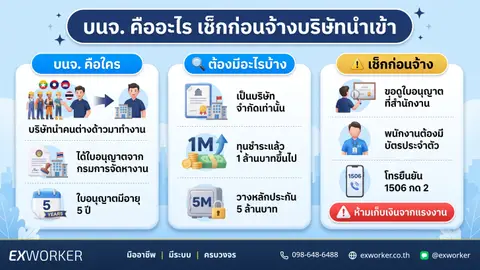
They entered through the import centre, hold a work permit issued for two years at a time, and are now near the end of the first term.
If your employee registered inside Thailand under a Cabinet resolution rather than entering under MOU, go to the work permit renewal service, which is a different legal group on a different timetable.
Start at the MOU import service — a different process from renewal.
Why it has to start before the contract ends, not after
Put another way, renewal is not optional; it is the way out of a duty the law has already imposed. If neither renewal nor repatriation happens, the exposure sits with the employer, not the employee.
An advantage of renewed workers that most employers do not know
The employment term for MOU workers
| Period | Substance |
|---|---|
| Work permit issued for | 2 years at a time |
| Renewable for a further | not more than 2 years |
| Maximum term before returning to the country of origin | not more than 4 years |
What the renewal round involves
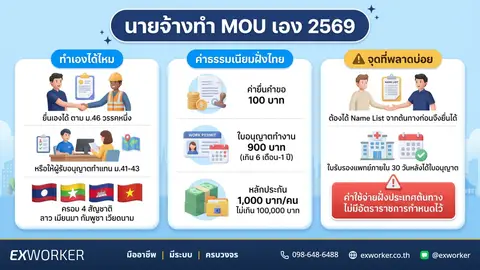
- Renewing the written employment contract Section 46 paragraph three requires the employer to make the contract in writing, keep it at the place of business, and give a copy to the employee. Failing to produce it when an officer asks carries a fine of up to 5,000 baht, and there is a Department of Employment notification setting the minimum items an MOU employment contract must contain.
- Renewing the work permit Filed with the Department of Employment together with the employer's and the employee's document sets.
- The visa and permission-to-stay side So that the period of permitted stay matches the new work permit term.
- Related matters in the same round Such as health insurance or social security, and keeping the data consistent across every system.
Documents usually required
- The new employment contract (we draft it to include the items the notification prescribes)
- The existing work permit and the employee's original passport
- Employer documents — an identity card for an individual, or a company certificate within the prescribed validity plus the identity card of the authorised director for a juristic person
- Powers of attorney on both the employer's and the foreign national's side, with duty stamps at the correct rates
- Other supporting documents as required by the local office
Document lists differ between provinces. We check with the employment office responsible for your area before filing in every case.
Costs
The figure in the price box above is our handling fee, per employee.
Why employers have us handle it
- We check each worker's contract end date and schedule the work backwards from it, instead of waiting for the date to arrive
- We can say which workers are near the term ceiling, which needs different planning from an ordinary renewal
- We draft the employment contract to include the prescribed items, rather than using a generic template that omits them
- Several employees can be handled at once and filed in batches by similar end dates
- We explain in advance that in the renewed term the employee has broader freedom to change employer than in the first
Frequently asked questions
How far ahead of the contract end should it start?
The earlier the better, because the round covers contract work, work permit work and the permission-to-stay side, and each area's queue differs. We check the contract end date for free and tell you when your case should start.
The contract has ended and nothing was renewed — what now?
It has to be assessed case by case, because the law imposes a duty to send the worker back when the contract ends, unless renewal or a move to a new employer happens within the prescribed period. Send us the documents first and we will say honestly what routes remain.
After renewal, can the employee change employer?
In the renewed term the early restriction on changing employer does not apply, under Section 51 paragraph three, so the employee has more freedom than in the first term. If you want to keep your people, discuss terms before the renewal round.
Is MOU renewal the same as the 11 December 2026 work permit renewal?
They are different. The 11 December 2026 round belongs to the Cabinet-resolution group registered inside the country, while this page is for workers imported under MOU, whose terms end individually and are not tied to that single deadline.
What happens after the full four years?
At the end of the term the worker must return to the country of origin before being brought back in. The transitional conditions are adjusted from time to time, so check with the provincial employment office or hotline 1694 before planning. We check case by case when we take a case on.
Can the employee keep working during the renewal?
It depends on whether the work permit and the right to stay have ended as at that date. We check the status when we take the case on, and say plainly if there is an exposed period.
Read more on the same subject
- MOU workers completing two years: how to renew the contract correctly
- MOU migrant worker import service
- Work permit renewal service for the Cabinet-resolution group
Let us look at your case
Send photos of the work permits and passports of all the MOU workers you have over LINE. We will work out who ends their contract when, who can be renewed, who is close to the term ceiling, and then sequence the work so everyone is covered in time.
Sources
- Royal Decree on the Management of Foreign Workers' Employment B.E. 2560, as amended by the Second Edition B.E. 2561 — Sections 46, 51, 52, 55, 113 and 115/1
- Department of Employment — public manual on bringing foreign workers to employers in Thailand under MOU
- Department of Employment notification on the items required in employment contracts for foreign workers entering under MOU (Government Gazette, Volume 140, Special Part 268 Ngor, 27 October 2023)
- Ministerial Regulation on Fees B.E. 2563, as cited in the Department of Employment public manual